Tag: Container Transport

  • 2026 Guide to Moving Shipping Containers in SE QLD

    2026 Guide to Moving Shipping Containers in SE QLD

    A shipping container is far more than a simple steel box; it is a high-value asset that requires the same level of meticulous care as a prestige vehicle. In the diverse terrain of South East Queensland, a successful container relocation depends on far more than just a heavy-duty engine. You likely worry about a multi-tonne rig getting bogged in soft Logan soil or the hidden costs associated with navigating tight overhead clearances and power lines. These are not just minor inconveniences; they are significant logistical risks that require a disciplined, expert approach to manage effectively.

    We agree that the safety of your property and your cargo should never be left to chance. This guide promises to equip you with the professional clarity needed to master the logistics of your move, ensuring a seamless, damage-free result for both your container and the ground it sits on. We will examine the critical differences between tilt tray and side loader equipment, clarify the 2026 council placement regulations for the Gold Coast and Logan, and provide a methodical framework for site preparation that removes all uncertainty from your next transport project.

    Key Takeaways

    • Discern the critical differences between tilt tray and side loader footprints to ensure your property can safely accommodate the selected transport method.
    • Master the technical logistics of a damage-free container relocation by identifying site-specific risks such as soft ground or low-hanging overhead wires.
    • Ensure full compliance with 2026 Logan and Gold Coast council regulations regarding temporary container placement and local permit requirements.
    • Implement the “Done Wright” site preparation strategy to protect both your high-value asset and the long-term integrity of the ground it sits on.
    • Learn how to coordinate your transport schedule to avoid peak-hour congestion on major SE QLD arterials like the M1 and Logan Motorway.

    What is Professional Container Relocation?

    Professional container relocation is the disciplined, technical process of moving heavy-gauge steel structures, specifically ISO shipping containers and modified site sheds, across the diverse landscapes of South East Queensland. While many view these units as mere industrial boxes, a specialised transport provider recognises them as high-value assets that require meticulous handling. This service involves more than just transit; it encompasses a comprehensive logistical plan that accounts for structural integrity, weight distribution, and the delicate nature of internal modifications. Relying on standard towing equipment for such a task is a significant risk. Conventional tow trucks often lack the hydraulic precision and the specific tray length required to manage the immense footprint and torsional stress of 20ft or 40ft units without causing structural damage.

    At Done Wright Towing & Transport, we approach every container relocation with the same level of security-focused care typically reserved for prestige classic cars. Whether the unit is destined for a construction site in Logan or a residential block on the Gold Coast, the objective remains a damage-free execution. This requires a deep understanding of Intermodal container standards, which dictate how these units must be supported and secured during transit to maintain their engineering specifications. Treating industrial equipment with this calibre of respect ensures that doors remain aligned and corner castings stay true, preserving the long-term utility of your investment.

    Standard ISO Containers vs. Modified Site Sheds

    The structural requirements for moving a standard sea container differ vastly from those of a modified site office or portable building. A basic ISO unit is designed for rugged durability, yet it still requires precise placement to prevent warping. Conversely, modified units often feature fragile internal fittings, electrical wiring, and glass windows. These elements are highly susceptible to damage during the loading and unloading process. Utilising specialised shipping container transport methods is essential for these units, as the tilt angle must be managed with extreme care to avoid internal load shifts or structural cracking of non-steel components.

    Relocating Full vs. Empty Units

    The complexity of a move increases significantly when relocating a “loaded” container. Safety protocols must be strictly followed to mitigate the risks associated with internal weight shifts. It is a fundamental rule of transport that the heavy end of the cargo must be positioned correctly on the truck, typically towards the front, to maintain axle balance and braking efficiency. In Queensland, legal weight limits and height restrictions for “high-cube” containers are strictly enforced by the Department of Transport and Main Roads. Every container relocation involving contents must be meticulously planned to ensure the load is secured against lateral movement, protecting both the cargo and other road users on the M1 or Logan Motorway.

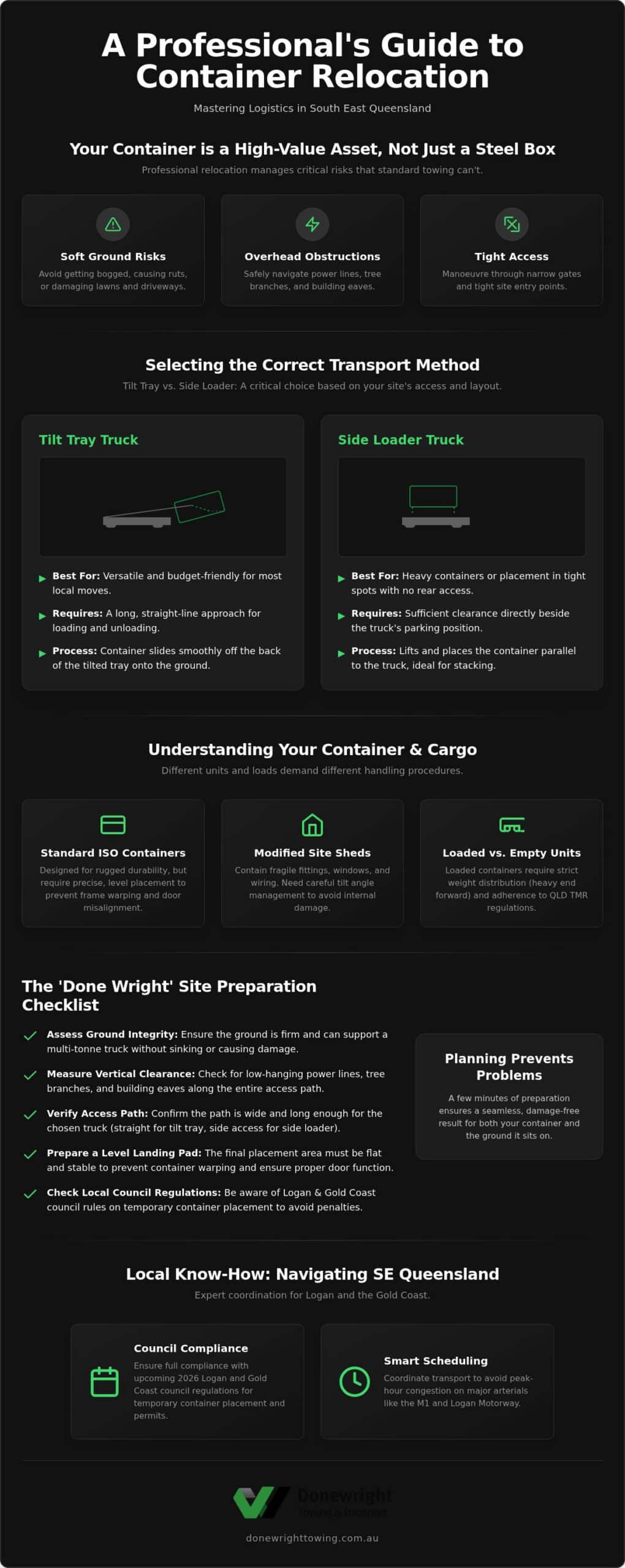
    Selecting the Correct Transport Method: Tilt Tray vs. Side Loader

    Choosing the right vehicle for your container relocation is a technical decision that impacts both the safety of your asset and the total project cost. In South East Queensland, the two primary options are tilt tray trucks and side loaders, each offering distinct operational advantages based on your site’s physical constraints. While side loaders are often associated with heavy port logistics, tilt trays are frequently the more versatile and budget-friendly choice for local moves between Logan and the Gold Coast. Successfully managing these units requires the same level of precision found in specialised machinery transport, ensuring every odd-sized or modified unit is handled with technical proficiency and care.

    The “footprint” of the truck during the loading and unloading phase is the most critical factor to consider. A mismatch between the equipment and the site often leads to property damage or the truck getting bogged. Before booking, you must assess whether your site offers a long, straight approach or if the unit needs to be placed parallel to the transport vehicle. If you’re unsure which method suits your property, consulting with a specialist who understands secure container logistics can prevent costly site delays and equipment mismatches.

    The Versatility of Tilt Tray Trucks

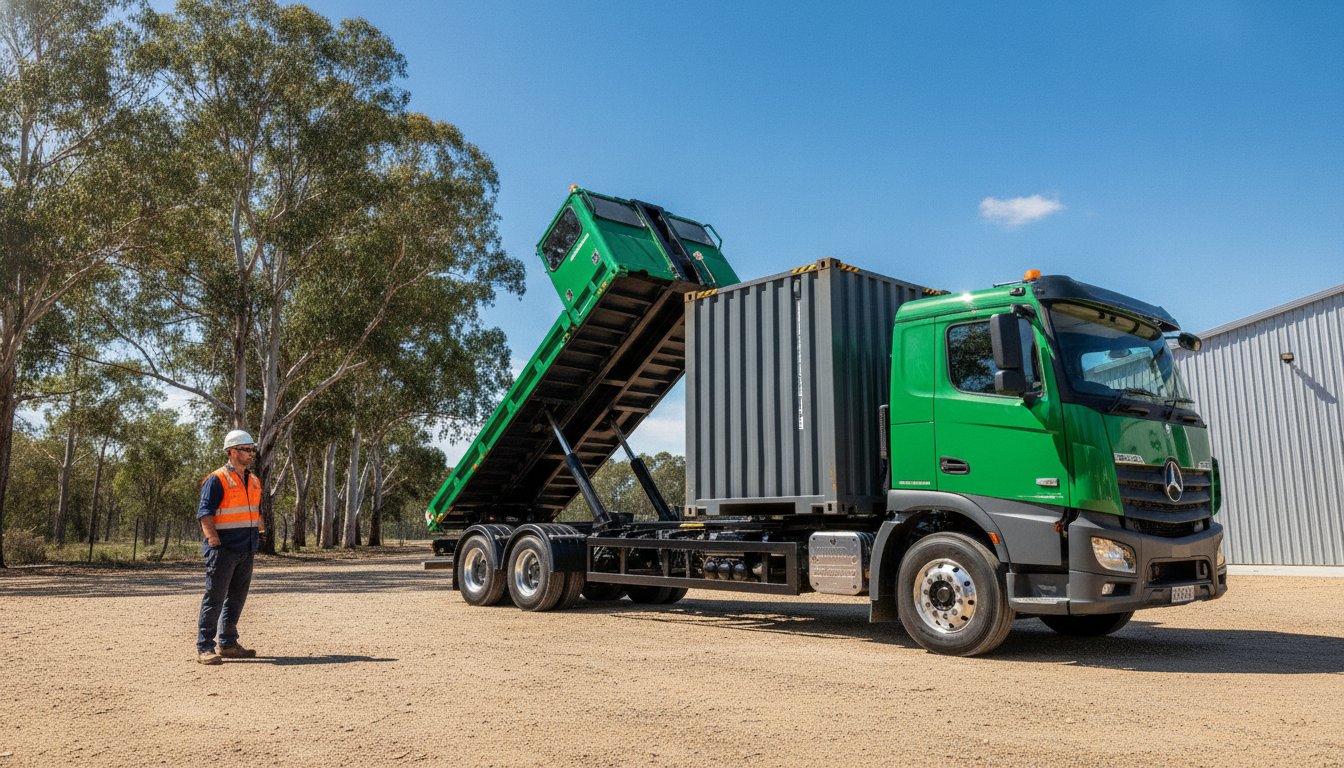
    A tilt tray is a specialised transport vehicle with a hydraulic bed that inclines to ground level. This mechanism allows the truck to slide the container onto the ground with surgical precision, making it the preferred method for residential deliveries and site shed placement. These trucks are ideal for sites with limited side clearance, such as a narrow driveway flanked by fences or foliage. However, they require a significant “runway” space in front of the drop-off point. Typically, you’ll need at least 20 to 30 metres of straight, clear space to allow the driver to pull forward as the container gently makes contact with the surface.

    When to Use a Side Loader

    Side loaders operate via a “parallel park” manoeuvre, lifting the unit directly to the side of the truck using dual hydraulic cranes. This is the superior method when you need to drop a container in a tight spot between two existing structures or along a narrow boundary where a long runway isn’t available. It’s important to remember that side loaders require a level, hard-stand surface to operate safely. They utilise heavy stabiliser legs to balance the weight during the lift. If the soil is soft or the ground is uneven, there’s a high risk of the stabiliser legs sinking, which can jeopardise the structural integrity of the container or the safety of the operator.

    Essential Site Preparation Checklist for a Smooth Move

    The “Done Wright” philosophy dictates that 90% of a successful container relocation occurs before our specialised tilt tray even leaves the Stapylton hub. Meticulous site preparation is the single most effective way to de-risk your project and ensure the safety of your property. In the diverse geology of South East Queensland, from the reactive clays of Logan to the sandy loams of the Gold Coast hinterland, assuming the ground is stable is a costly mistake. A poorly prepared site often results in the truck sinking or, once placed, the container settling unevenly. This lack of balance places undue torsional stress on the steel frame, which inevitably leads to the container doors jamming or failing to seal correctly.

    To facilitate a precision landing, we recommend marking the four corners of the drop zone with high-visibility stakes or spray paint. This provides the operator with a clear visual target and ensures the unit is positioned exactly where you intended. If you’re planning to place the container on a specific foundation, such as concrete pads or piers, these must be perfectly level and structurally sound before the transport vehicle arrives. Taking the time to survey your entry point is an act of expert guardianship over your investment. We treat every delivery with the same technical proficiency used for high-end machinery transport, but our precision is limited by the site’s readiness.

    By following a methodical checklist, you transform a potentially stressful logistical task into a controlled, professional operation that respects both the craftsmanship of the container and the integrity of your land. This disciplined approach eliminates the uncertainty that often plagues difficult sites, leading to a state of confidence in the final result. Every container relocation we undertake is a partnership between our technical skill and your site readiness, ensuring the long-term protection of your high-value asset.

    Ground Conditions and Drainage in SE QLD

    Identifying “soft spots” is vital, especially after the heavy rainfall common in Logan and the Gold Coast. A 10-tonne truck carrying a container can easily penetrate waterlogged soil, leading to expensive recovery costs. We advise using timber dunnage or concrete sleepers at each corner to elevate the unit. This creates a protective barrier against ground moisture, prevents rust, and ensures adequate drainage to stop water pooling beneath the floor.

    Clearance and Access Requirements

    Precision requires space. For a standard 20ft container relocation, you must provide at least 20 metres of straight-line approach to allow the tilt tray to manoeuvre safely. Always look up; “silent killers” like low-hanging power lines, tree branches, and residential eaves pose significant risks. Ensure your entry gate is at least 3.5 metres wide to accommodate heavy rigid trucks without risking damage to your fencing or the vehicle’s mirrors.
    2026 Guide to Moving Shipping Containers in SE QLD

    Executing a seamless container relocation in South East Queensland requires a sophisticated understanding of both regional traffic patterns and local government frameworks. From our strategic hub in Stapylton, we observe how the logistics of the Gold Coast and Logan corridors demand precise timing. To ensure a disciplined delivery, we meticulously plan routes that avoid the heavy congestion of the M1 and Logan Motorway during peak periods. Coordinating a move between 10:00 am and 2:00 pm is often the most reliable way to maintain our schedule and protect your asset from the risks associated with stop-start heavy traffic. This level of local knowledge is a hallmark of a professional towing service that prioritises security over speed.

    For those managing long-distance or interstate projects, “backloading” offers a highly efficient logistical solution. By utilising the empty return leg of a previous journey, we can significantly reduce the financial investment required for your move without compromising our high standards of care. This methodical approach to resource management ensures that even complex, multi-state relocations are handled with technical proficiency and elite handling. Whether you are moving a single unit or an entire construction site office, our Stapylton base serves as the perfect launch point for expansive regional reach.

    If you require expert guidance on navigating these complex transport frameworks, contact our specialist team for a detailed logistics assessment today.

    Council Permits and Road Restrictions

    Regulatory compliance is a critical component of the “Expert Guardian” personality we bring to every task. In the Gold Coast City Council region, a shipping container can typically remain on a private property for up to 30 days without formal building approval. Logan City Council maintains a similar 30-day window for household goods, though placement on a footpath is strictly limited to 14 days and requires a specific local law permit. Beyond council rules, all transport must strictly adhere to the Heavy Vehicle National Law (HVNL). This ensures that load restraint and height clearances for high-cube units meet rigorous safety standards before we enter any public roadway.

    Coordination and Site Communication

    The final stage of a successful container relocation depends on clear, disciplined communication between the client and the transport coordinator. We highly recommend appointing a dedicated on-site “spotter” to assist the driver during complex hydraulic manoeuvres. This individual serves as a vital set of eyes, monitoring for property hazards that may not be visible from the truck cabin. Effective coordination also involves managing site access for construction projects to ensure our specialised tilt tray does not cause downtime for other trades. By identifying all potential hazards before booking, you allow us to maintain the steady, structured rhythm that defines our operational excellence.

    The Done Wright Approach: Protecting Your High-Value Assets

    At Done Wright Towing & Transport, we don’t view a shipping container as just a utilitarian industrial vessel. We treat it as a high-value asset, applying the same meticulous care and security-focused protocols we use for prestige classic cars. As an independently owned Australian family business, we provide a level of personalised service that large-scale logistics firms often lack. Our commitment to “Correct Execution” is a verbal promise that we refuse to cut corners on safety, timing, or specialised equipment. From our central Stapylton hub, we offer a rapid and reliable response across Logan, the North Gold Coast, and the wider South East Queensland region, ensuring every container relocation is conducted with disciplined, technical precision.

    The personality we bring to every project is that of the “Expert Guardian.” We understand that the emotional and financial stakes of moving a site office or a modified container are significant. By maintaining a steady, structured rhythm throughout the transport process, we de-risk the decision-making process for our clients. Whether you are moving a basic 20ft unit or a complex portable building, our approach remains methodical and planned. This elite handling ensures that your investment is respected and that the logistics are executed with a focus on long-term reliability and safety.

    Precision Handling for Site Sheds and Offices

    Modified units such as tiny homes, portable lunchrooms, and site offices require an “Expert Guardian” approach to transport. Standard logistics methods often ignore the risk of internal vibration and torsional stress, which can easily dislodge electrical fittings, damage cabinetry, or crack internal linings. We focus on minimising jarring during the hydraulic loading process to protect these intricate internal fit-outs from structural fatigue. By utilising non-abrasive securing methods and specialised damage-prevention technologies, we ensure that custom paintwork and corporate signage remain pristine throughout the journey. You can see our technical proficiency in action by reviewing our site shed relocation case study, which demonstrates our ability to handle complex, high-value assets with elite care.

    Fully Insured and Licensed Peace of Mind

    Trust in the transport industry is built on the backbone of verifiable protection and elite credentials. When we state that our operations are “fully insured,” it means your asset and its specific contents are covered by comprehensive policies designed for high-value transport, providing a level of security that generalists cannot match. Our drivers are not merely operators; they are highly experienced specialists who understand the intricate engineering and weight distribution requirements of heavy-gauge steel structures. This non-negotiable standard of licensing and experience ensures your container relocation is fully compliant with all Queensland transport regulations and HVNL standards. Operating from our Stapylton hub allows us to maintain a structured, professional response that gives our clients total confidence in our methodical execution.

    Secure the Future of Your High-Value Asset

    A successful transport project is the result of disciplined planning and technical expertise. By mastering the differences between tilt tray and side loader footprints, you’ll ensure your property remains undamaged while your asset is placed with surgical accuracy. A level, stable site is the foundation of a trouble-free delivery; it prevents structural stress and ensures your container remains functional for years to come. Whether you’re navigating the regulatory landscape of the Gold Coast or the reactive soils of Logan, this methodical approach removes the risk of costly site delays.

    Done Wright Towing & Transport operates from a strategic hub in Stapylton, providing family-owned care for every high-value asset we handle. We’re fully licensed and insured for QLD-wide moves, specialising in the prestige-level handling of containers and site sheds. Trusting your container relocation to a specialist who values engineering and craftsmanship is the final step in ensuring a damage-free result.

    Get a Professional Container Relocation Quote from Done Wright and move your asset with total confidence.

    Frequently Asked Questions

    Do I need a permit to move a shipping container in Logan or the Gold Coast?

    Both Gold Coast and Logan City Councils allow the temporary placement of a container on private property for up to 30 days without a formal permit. However, if you intend to place the unit on a nature strip or road reserve, you must obtain a local law permit. Logan typically restricts these roadside placements to a maximum of 14 days. It is essential to distinguish between temporary storage for a move and permanent structural placement, as the latter requires building approval.

    Can a tilt tray truck move a 40ft container, or do I need a side loader?

    While a standard tilt tray is the preferred vehicle for 20ft units, a 40ft container relocation typically requires a side loader or a specialised “super-tilt” trailer. The immense length and weight of a 40ft unit exceed the capacity of most rigid tilt tray trucks. We recommend assessing your site’s access carefully, as a side loader lifts from the side, whereas a super-tilt requires a very long, straight approach to slide the unit into position.

    Does the container need to be empty before relocation?

    A container does not necessarily need to be empty, but it must be packed with a focus on weight distribution and load restraint. Every container relocation involving contents carries the risk of internal shifting during the tilt process. To ensure your items are packed securely, you can learn more about Non Stop Furniture Removals for professional moving support. You must ensure the heavy end of the cargo is identified so the driver can position the unit correctly on the truck, ensuring the vehicle remains within legal axle weight limits and maintains stability on the M1 or Logan Motorway.

    How much space does a truck need to drop off a 20ft shipping container?

    To safely deliver a 20ft container via tilt tray, you need approximately 20 metres of straight-line space in front of the drop-off point. This “runway” allows the truck to pull forward as the container slides off the hydraulic bed. Additionally, you must ensure a minimum gate width of 3.5 metres and an overhead clearance of 4.8 metres. This prevents the vehicle from making contact with residential eaves, low-hanging tree branches, or power lines during the manoeuvre.

    What happens if the truck gets stuck on my property during the move?

    If a transport vehicle becomes bogged, the responsibility for recovery costs and any property damage generally rests with the site owner. This highlights the critical importance of assessing ground stability before the truck arrives. If your property in the Gold Coast hinterland or Logan has experienced recent heavy rain, the soil may be too soft to support a 10-tonne laden vehicle. We advise rescheduling the move if the ground cannot support the weight without sinking.

    Can you move a modified container that has glass windows and doors?

    Yes, we specialise in the precision transport of modified site sheds and portable offices that feature fragile glass components. These assets require a disciplined, “prestige” level of care to minimise vibration and jarring during transit. Our operators use specialised hydraulic controls to manage the tilt angle with extreme precision, ensuring that internal fit-outs and external glass remain intact. We treat these modified units as high-value investments rather than simple industrial cargo.

    Do you offer interstate container relocation from Queensland?

    How do I level the ground before the container arrives?

    The most reliable way to level your site is by installing concrete pads, piers, or treated timber sleepers at the four corner points where the container will sit. A level foundation is essential because any twist in the steel frame will cause the doors to jam and compromise the unit’s seal. Elevating the container on dunnage also facilitates airflow beneath the floor, which is a vital step in preventing rust and protecting the long-term integrity of your asset.
  • Container Tow Truck: The Ultimate Guide to Professional Relocation in 2026

    Container Tow Truck: The Ultimate Guide to Professional Relocation in 2026

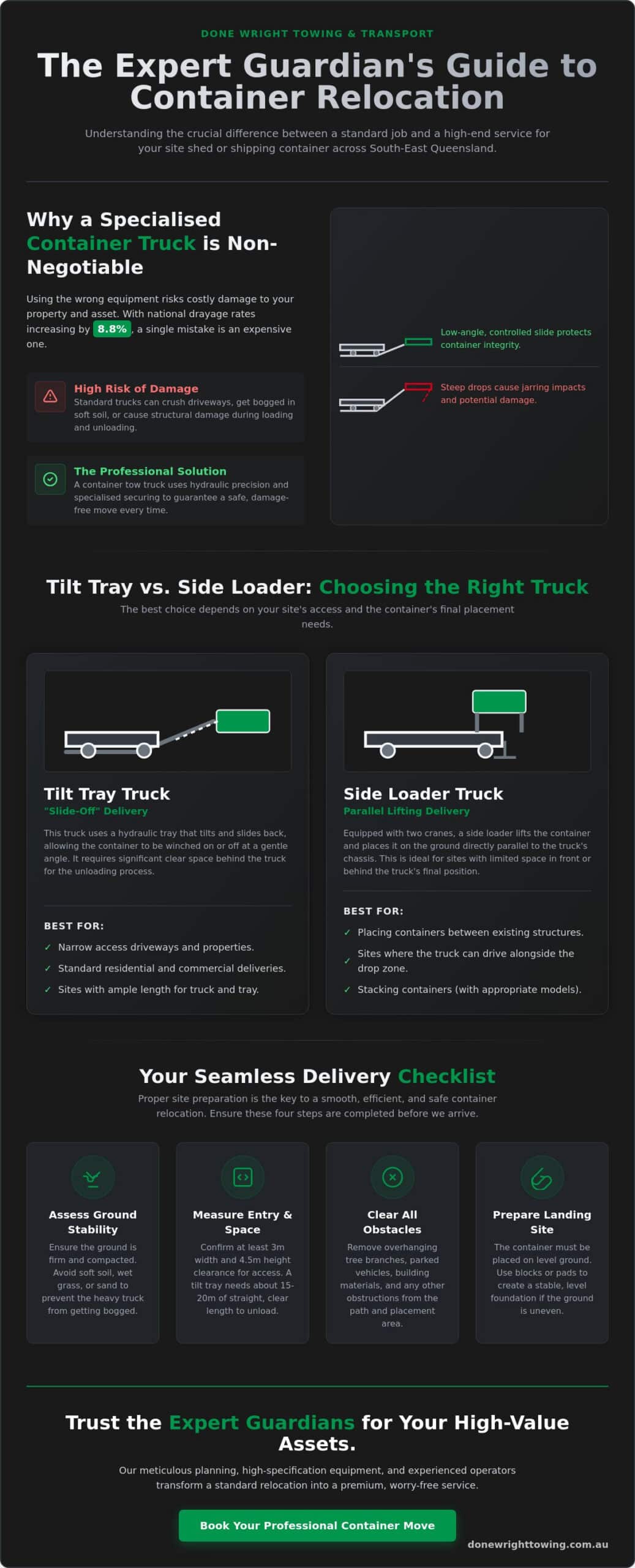
    What if the difference between a seamless site shed delivery and a costly recovery bill was simply the mechanics of the truck’s tray? Many property owners across the Gold Coast and Logan suburbs feel a genuine sense of dread when a heavy-duty vehicle enters their driveway, fearing the weight might crush their pavers or leave the unit bogged in soft soil. These concerns are valid, especially as the national drayage market has seen an 8.8 per cent rate increase this year; any operational delay or damage is an expensive mistake. Securing a professional container tow truck is the most effective way to ensure your high-value asset is handled with the meticulous care it deserves.

    We understand that your shipping container or site office is more than just a steel box; it’s a significant investment that requires an “Expert Guardian” approach. This guide will show you how specialised tilt-tray mechanics and precision planning ensure a damage-free relocation across South-East Queensland. We’ll explore the technical requirements for narrow access sites, the critical importance of level ground, and the specific site preparation steps you need to take to avoid the hidden costs of a failed delivery.

    Key Takeaways

    • Learn how hydraulic precision and controlled winch systems eliminate jarring impacts to protect your container’s structural integrity during transit.
    • Distinguish between the “slide-off” delivery of a tilt tray and the parallel lifting of a side loader to navigate tight access points across South-East Queensland.
    • Master essential site preparation techniques, including assessing ground stability and measuring entry depth, to ensure a container tow truck operates safely on your property.
    • Understand the “Done Wright” philosophy of meticulous planning that transforms a standard relocation into a high-end service for site sheds and shipping containers.

    What is a Container Tow Truck and Why Is It Necessary?

    A container tow truck is a specialised, heavy-duty tilt tray vehicle specifically engineered to manage the unique dimensions and concentrated mass of shipping containers and site sheds. Unlike a standard recovery vehicle, these trucks possess the structural reinforcement and extended bed length required to safely transport ISO-standard units. The defining feature of a professional container tow truck is its sophisticated hydraulic tilt system. This mechanism allows the tray to create a low-angle incline, ensuring that your asset slides onto the bed with minimal stress on its frame. This precision is vital for maintaining the structural integrity of portable buildings and site sheds that may contain sensitive internal fit-outs.

    The necessity for such specific machinery stems from the nature of intermodal freight transport. While containers are built for global durability, their weight distribution is often uneven, particularly if they’re partially loaded or modified into site offices. A standard tow truck simply doesn’t have the Gross Vehicle Mass (GVM) capacity or the specialised winching power to control a 2.3-tonne empty steel box, let alone a fully fitted-out construction shed. Using the wrong equipment doesn’t just risk the container; it puts your property and the public at risk.

    The Difference Between General Towing and Container Transport

    Relocating a 20ft shipping container presents engineering challenges that general towing services aren’t equipped to handle. The primary concern is the securement of the load. A professional container tow truck utilises specialised chain-pull systems and heavy-duty twist locks that interface directly with the container’s corner castings. This ensures the unit remains an extension of the truck’s chassis during transit. In Queensland, transporting these units often involves navigating strict legal requirements. If a container or site shed exceeds the standard 2.5-metre width, specific “wide load” permits and signage are mandatory. Our disciplined approach ensures every move complies with Department of Transport and Main Roads regulations, providing you with total peace of mind.

    When to Call a Professional Container Mover

    Knowing when to engage a specialist can save you from costly site delays or property damage. If you’re moving a container from a residential block to a new property, the narrow access common in Gold Coast suburbs requires a driver with meticulous spatial awareness. On construction projects in Logan or Stapylton, site sheds often need to be repositioned as the build progresses. These moves require a delicate touch to avoid disrupting the internal electrical or plumbing connections. Additionally, emergency relocations are sometimes necessary. If a site faces sudden flooding risks or access issues due to local roadworks, a professional team can quickly and safely extract your assets before the situation worsens. The same principle applies to other high-value assets on the road; owners seeking caravan towing Gold Coast services face identical concerns about specialist handling and damage-free recovery.

    The Mechanics of Meticulous Loading: How We Protect Your Asset

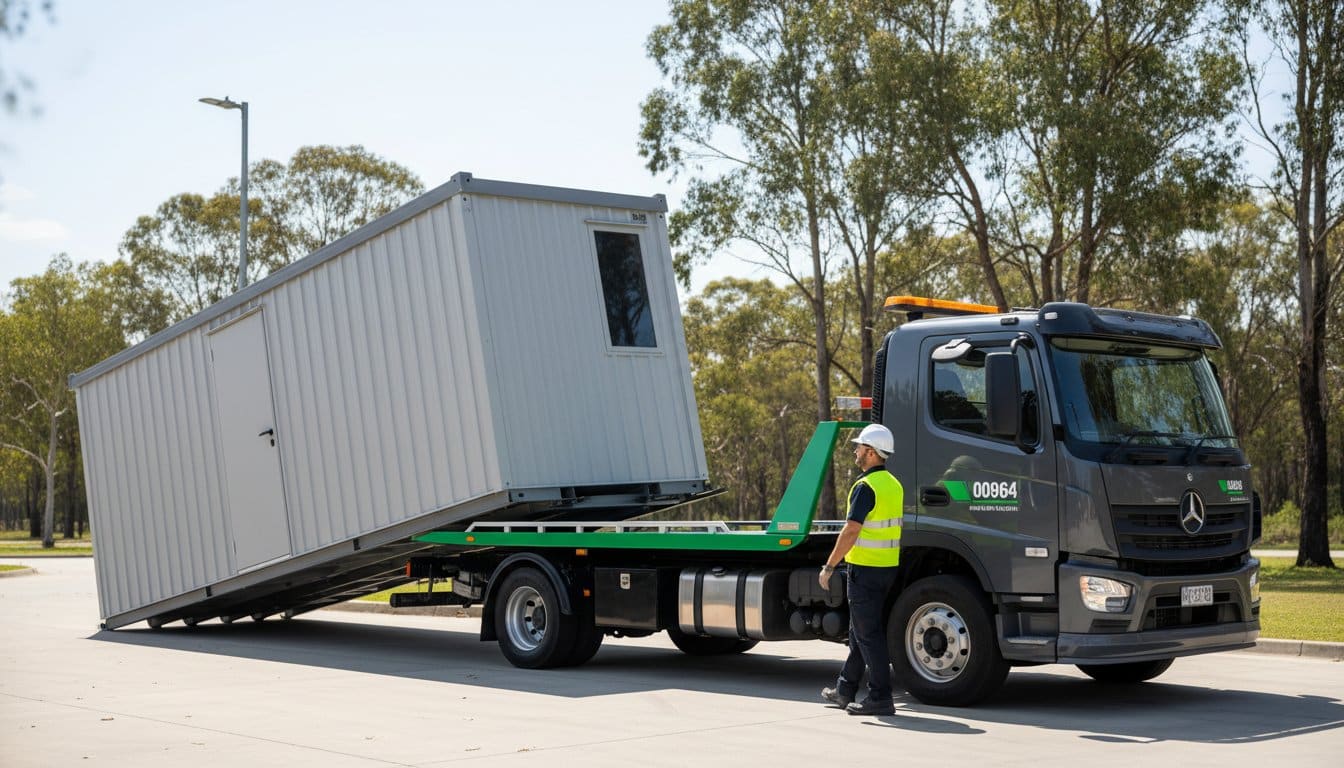
    Loading a heavy-duty asset isn’t a task for the impatient. It requires a disciplined, methodical approach that treats every shipping container or site shed as a high-value investment rather than just another job. A professional container tow truck achieves this level of protection through a high-specification hydraulic tilt tray mechanism. This system allows the tray to extend and tilt to a precise, low-angle incline, creating a seamless path from the ground to the truck bed. By maintaining this shallow angle, we prevent the frame of the container from flexing or twisting; this is critical for modified units that have had their structural rigidity altered by the installation of windows or doors.

    The winching process is where the “Expert Guardian” philosophy truly shines. We utilise a controlled winch system to manage both the ascent and descent of the unit. This prevents the jarring impacts often associated with less experienced operators who let the container drop onto the ground during the final stage of delivery. Level loading is paramount. If the container isn’t kept parallel to the tray during the pull, internal contents can shift, potentially causing expensive damage to internal fit-outs or stored equipment. We use non-abrasive equipment and specialised handling techniques to ensure the exterior finish of your site shed remains pristine throughout the process.

    Step-by-Step: The Loading Process

    Precision begins before the winch is even engaged. Reversing the container tow truck with millimetre precision to the very edge of the container ensures a direct, stable line of pull. We secure the winch cables to the bottom corner castings, providing the most robust anchor points for the lift. Every move is executed as a slow-motion pull. Speed is the enemy of safety. A deliberate pace allows the operator to monitor the container’s balance and adjust for any ground shifts or weight transfers in real-time, ensuring the asset remains perfectly balanced.

    Securing the Load for SE QLD Roads

    Safety doesn’t end once the container is settled on the tray. We adhere to rigorous FMCSA safety regulations regarding intermodal equipment, which inform our high standards for cargo securement. With the 2026 International Roadcheck placing a special focus on cargo securement, our meticulous approach is more relevant than ever. We utilise heavy-duty transport chains and tensioners, but the gold standard remains the “twist lock” system. These locks mechanically bond the container to the chassis, providing absolute security on the highway. If you’re planning a relocation, choosing a team that prioritises this professional container transport methodology is essential for a stress-free experience.

    Container Tow Truck: The Ultimate Guide to Professional Relocation in 2026

    Tilt Tray vs. Side Loader: Choosing the Right Truck

    Selecting the appropriate vehicle for your relocation is a decision rooted in spatial geometry and weight distribution. For the vast majority of residential and commercial projects in South-East Queensland, a container tow truck equipped with a tilt tray is the most efficient and cost-effective solution. This vehicle utilises the “slide-off” delivery method, where the tray tilts to the ground and the truck slowly moves forward, allowing the container to settle exactly where it’s needed. This process is a feat of precision that requires a clear, linear path in front of the drop-off point to ensure a smooth transition from the bed to the ground.

    While the tilt tray is our primary tool for 10ft and 20ft units, the choice depends entirely on your site’s unique constraints. Every container we move must comply with the standards set by the International Convention for Safe Containers, ensuring the unit can handle the stresses of transport. Whether you’re moving a basic storage box or a high-end site shed, understanding the footprint of the delivery vehicle is the first step toward a successful relocation.

    Tilt Tray Advantages for Local Transport

    The primary benefit of a tilt tray container tow truck is its superior manoeuvrability within the tight suburban streets of the Gold Coast and Logan. These vehicles can navigate residential driveways that would be impossible for larger, more cumbersome equipment. A tilt tray requires a minimum width of only 3 metres and a height clearance of 4.8 metres, making it ideal for sites with established trees or overhanging eaves. Because the unit slides directly onto the ground, there’s no need for secondary equipment like cranes or forklifts, which significantly reduces the logistical complexity and overall cost of the move.

    When You Might Need a Crane or Side Loader

    There are specific scenarios where the “Expert Guardian” approach necessitates alternative machinery. A side loader is generally required for 40ft containers or when a “parallel drop” is the only option. While a side loader has a slightly lower height requirement of 4.5 metres, it needs a substantial width of 6 metres to deploy its stabilising outriggers and cranes. If your project involves handling 40ft high-cube containers with payloads exceeding 10 tonnes, or if you need to lift a unit over a fence or stack containers at a busy industrial site, a specialised crane truck is the correct choice. These methods are essential when a truck cannot reverse directly to the landing spot, ensuring your asset is placed with millimetre accuracy regardless of obstacles.

    Site Preparation: Ensuring a Seamless Delivery in Stapylton and Beyond

    The success of a professional relocation is often determined long before the container tow truck arrives at your gate. Ground stability is the most critical factor in ensuring your asset remains level and secure over time. While reinforced concrete or cured asphalt provides the most reliable foundation, many commercial sites in Stapylton and residential blocks in the Gold Coast hinterland rely on natural earth. Uncompacted soil is a significant risk; it can lead to the truck becoming bogged during delivery or the container sinking unevenly over subsequent months. This subsidence puts immense pressure on the unit’s frame, potentially causing doors to jam and internal structures to warp.

    Precise measurement of the delivery environment is essential. We focus on two primary metrics: “Swing Room” and “Entry Depth.” A standard 20ft shipping container requires approximately 20 metres of straight-line clearance to allow the tilt tray to slide the unit off effectively. If your driveway has a sharp bend or a steep incline, the logistics become more complex. Our methodical approach involves calculating these clearances to the millimetre, ensuring the vehicle has enough room to manoeuvrer without risking damage to your landscaping or existing structures. To ensure your site is perfectly prepared, consult with our team for a professional site shed assessment today.

    The Access Checklist for Logan & Gold Coast Properties

    Navigating suburban environments requires a keen eye for overhead and lateral obstructions. Before booking your transport, we recommend a disciplined walk-through of the access path. You must ensure a minimum width of 3 metres and a vertical clearance of 4.8 metres to accommodate the height of the truck when the tray is in its tilted position. Common hazards include:

    • Low-hanging tree branches that can scratch the unit’s protective coating.
    • Service cables and power lines that may sit lower than the legal minimum.
    • Overhanging eaves or gutters on narrow residential driveways.
    • The orientation of the container: identify if the “door-end” needs to face the cabin or the rear for the perfect final placement.

    Ground Conditions and Drainage

    Placing a heavy steel asset directly onto bare, uncompacted soil is a recipe for long-term structural issues. In South-East Queensland, heavy seasonal rain can quickly turn a firm patch of grass into a swamp, causing the container to settle unevenly. We advocate for the use of specialised footings, such as concrete pads or treated timber sleepers, to distribute the weight. This provides a stable base and creates essential ventilation. Keeping the container off the ground prevents moisture from being trapped underneath, which is the primary cause of premature rust and corrosion. For a comprehensive guide on managing these variables, refer to The Ultimate Shipping Container Relocation Checklist for Stapylton & Logan to safeguard your investment.

    Done Wright: The Expert Guardian for Your Container Relocation

    Our “Done Wright” philosophy is a verbal promise of perfection and a commitment to correct execution. We don’t settle for “near enough” when it comes to the safety of your assets. This disciplined, detail-oriented approach ensures that every relocation is treated as a high-stakes mission rather than a routine task. Whether we’re moving a standard 20ft shipping container or a complex site shed, our team applies the same level of meticulous care that has made us a leader in prestige vehicle and machinery transport. If the placement isn’t perfect, the job isn’t finished.

    Every operator in our fleet is fully licensed and insured, possessing a deep respect for the engineering and craftsmanship of modern portable buildings. We understand the financial and emotional stakes involved in high-end transport. By utilising a specialised container tow truck, we provide a premium, security-focused service that general logistics providers simply cannot match. Our focus remains on precision, safety, and the total protection of your investment from the moment the winch is engaged until the final twist lock is released. This same commitment to protecting high-value assets extends across all our services, including professional caravan towing on the Gold Coast where GCM limits and damage-free handling are equally critical.

    Why Local Expertise Matters in SE QLD

    Operating across Stapylton, Logan, and the Gold Coast requires more than just technical skill; it demands intimate local knowledge. We understand the specific council regulations regarding container placement on residential and commercial properties, helping you avoid potential compliance issues. Our strategic location allows for rapid response times to sites in the Northern Gold Coast and Stapylton industrial hubs. For a deeper look at the logistical landscape of our region, explore our Shipping Container Transport in SE QLD: The 2026 Professional Guide.

    Ready to Move? Get Your Meticulous Quote

    Providing an accurate transport estimate is the first step in our methodical process. To ensure we deploy the right container tow truck for your specific needs, we require detailed information about both the collection and delivery points. This includes identifying any potential access hurdles such as steep gradients, narrow gates, or soft ground. We highly recommend providing clear photos and site descriptions, especially for difficult access areas. This transparency allows us to plan the move with “Expert Guardian” precision, eliminating surprises on the day. You can organise your container tow truck with Done Wright today to experience a relocation handled with elite care and professional authority.

    Securing Your Asset’s Future with Precision Relocation

    Successful relocation is a combination of engineering precision and local foresight. You’ve learned how hydraulic tilt-tray mechanics prevent structural flexing and why meticulous site preparation is the only way to avoid the hidden costs of soft ground or narrow access. Selecting a specialised container tow truck isn’t just about moving a box; it’s about partnering with a provider that respects the financial and operational value of your site shed or shipping container.

    Established in 2017, Done Wright has built a reputation as a trusted guardian for high-value assets across Logan, Stapylton, and the Gold Coast. As an Australian family business, we bring the same level of discipline to container moves that we apply to our prestige car and machinery transport services. We are fully licensed and insured, providing you with the security and peace of mind that only a meticulous specialist can offer. Book your meticulous container transport with Done Wright today and ensure your next move is executed with absolute precision. Your assets are in safe hands.

    Frequently Asked Questions

    Can a container tow truck move a fully loaded 20ft container?

    A standard tilt tray container tow truck is primarily designed for empty or lightly loaded 20ft units. While these vehicles have high GVM capacities, a fully loaded container can exceed the safe winching limit of the tray. If your container contains heavy machinery or high-density goods, we recommend verifying the total weight beforehand to determine if a side loader or crane is required for a safe lift.

    How much space does a tilt tray need to drop off a shipping container?

    To facilitate a “slide-off” delivery, you generally need a minimum of 20 metres of straight-line clearance in front of the drop-off point. This allows the truck to pull forward as the container settles. You should also ensure a width of at least 3 metres and a vertical clearance of 4.8 metres to avoid contact with overhanging eaves or tree branches during the tilting process.

    Will a container tow truck damage my concrete driveway?

    Damage is possible if the concrete is not engineered to support the combined weight of a heavy vehicle and a steel container. A loaded truck can weigh upwards of 20 tonnes, which may cause cracking in thin or unreinforced residential slabs. We use methodical loading techniques to distribute weight, but property owners should verify their driveway’s load-bearing capacity before the vehicle arrives.

    Do I need a permit to move a shipping container in Logan or Gold Coast?

    You typically don’t need a permit for a temporary container on private property, but local council regulations in Logan and the Gold Coast vary if the unit is used as a permanent structure. If the container is being placed on a nature strip or public roadway, a specific “Occupation of Road Reserve” permit is mandatory. We suggest contacting your local council’s planning department to confirm current 2026 requirements.

    Can you move site sheds and portable offices as well as containers?

    Yes, we specialise in building and construction transportation, including site sheds, portable offices, and lunchrooms. These units require a more delicate touch than standard shipping containers due to their internal fit-outs and glass windows. Our “Expert Guardian” approach ensures these high-value assets are moved with specialised equipment that maintains their structural integrity throughout the transit process.

    What happens if my container is stuck in soft mud?

    If a container becomes bogged in soft mud, extraction becomes a complex recovery operation. Attempting to winch a stuck unit can damage the container’s frame or the truck’s hydraulic system. In these scenarios, it’s often necessary to wait for the ground to dry or engage specialised recovery equipment. Proper site preparation is the best way to avoid these costly delays.

    How do I prepare the ground before the container tow truck arrives?

    The ground must be level and compacted to prevent the unit from sinking or tilting. We recommend placing treated timber sleepers or concrete pads under the four corners of the container. This provides a stable foundation and creates essential ventilation to prevent rust. Ensuring the area is clear of debris and overhead obstructions will allow the container tow truck to operate with maximum precision.

    Do you offer interstate container transport from Stapylton?

    We provide interstate backloads from our operational hub in Stapylton to various locations across Australia. This service is ideal for non-urgent relocations where you can benefit from a more cost-effective transport solution. Our team manages the entire logistical process, ensuring your shipping container or site shed is delivered safely across state borders with the same meticulous care as our local moves.