Tag: container relocation

  • Shipping Container Towing in Stapylton & SE QLD: The 2026 Professional Guide

    Shipping Container Towing in Stapylton & SE QLD: The 2026 Professional Guide

    What if the most precarious moment of your relocation isn’t the highway transit, but the final ten metres of the “drop zone” on a soft Logan site? You likely recognise that professional shipping container towing is a disciplined engineering task, not just a simple haulage job. It’s natural to feel concerned about a heavy truck getting bogged in South-East Queensland’s unpredictable soil or your valuable contents shifting during the steep tilt-loading process. These are valid anxieties for anyone who treats their assets with the care and security they deserve.

    We’re here to provide the meticulous clarity you need for a seamless, damage-free transition. By following this 2026 professional guide, you’ll master the logistics of container relocation with expert advice on tilt-tray transport and rigorous site safety standards. We’ll examine the cost-efficiency of tilt-trays versus crane hire, detail the essential requirements for a stable landing area, and show you how to keep your site works perfectly on schedule through methodical, elite handling. From Stapylton to the coast, we’ll ensure your assets arrive with the precision that modern logistics demands.

    Key Takeaways

    • Learn why specialised tilt-tray transport is the superior choice for precise, ground-level placement of 10ft and 20ft containers.
    • Understand the technical physics of the 45-degree winching process and the critical role of heavy-duty twist-locks in asset security.
    • Master site preparation by identifying the 20-metre straight-line clearance required for a safe “drop zone” and assessing ground stability.
    • Ensure your project adheres to the 2026 Load Restraint Guide and NHVR standards for compliant and legal shipping container towing.
    • Leverage the expertise of a Stapylton-based specialist to coordinate complex logistics across Brisbane, Logan, and the Gold Coast.

    Understanding Shipping Container Towing & Transport Logistics

    Shipping container towing involves more than simply moving a steel box from one location to another. It is a specialised logistical operation utilising tilt-tray trucks designed for ground-level loading and unloading without the need for external lifting equipment. An intermodal container is a robust piece of engineering, yet it requires delicate handling to prevent structural stress or internal damage. In regions like Stapylton and Logan, this service is essential for those who value precision and asset protection over basic haulage.

    Our “Expert Guardian” approach defines every relocation we undertake. We don’t view a unit as mere cargo; we treat it as a high-value asset that demands meticulous care. Whether we are positioning a site shed in a bustling Stapylton industrial hub or delivering a private storage unit to a Logan backyard, our focus remains on security and disciplined execution. This methodical mindset ensures that your investment remains in the same condition it was in before the winching process began.

    Tilt-Tray vs. Sideloader: Which Do You Need?

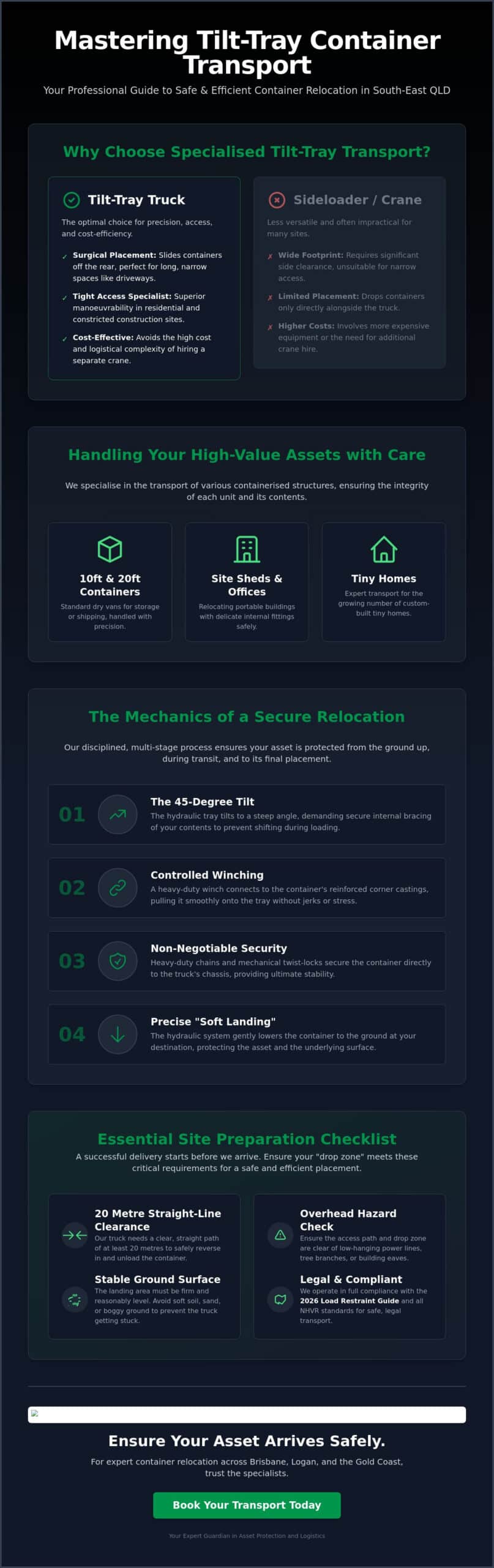
    Choosing the right equipment is vital for a successful delivery. Tilt-trays offer superior manoeuvrability in tight residential spaces compared to sideloaders. While a sideloader requires significant width to drop a container alongside the truck, it often fails in narrow Gold Coast driveways or restricted construction sites. A tilt-tray slides the unit off the rear of the bed, allowing for surgical placement in long, thin spaces. This method also provides a significant cost-benefit by avoiding expensive external crane hire for standard 20ft units. It’s the most efficient way to achieve ground-level access without the logistical headache of multiple machines on site.

    Container Types We Specialise in Moving

    We specialise in moving standard 10ft and 20ft dry vans, but our expertise extends to more complex structures. We frequently relocate modified site sheds, portable offices, and the growing number of “tiny homes” appearing across South-East Queensland. These modified units often have delicate internal fittings that require a steady, level transport process. Handling high-cube or refrigerated (reefer) units also requires specific weight considerations and a deep understanding of the load’s centre of gravity. This level of technical proficiency is also applied to our machinery transport services, where protecting the engineering integrity of the asset is the primary objective. We ensure every unit is secured with heavy-duty chains and twist-locks, regardless of its size or purpose.

    The Mechanics of Tilt-Tray Container Relocation

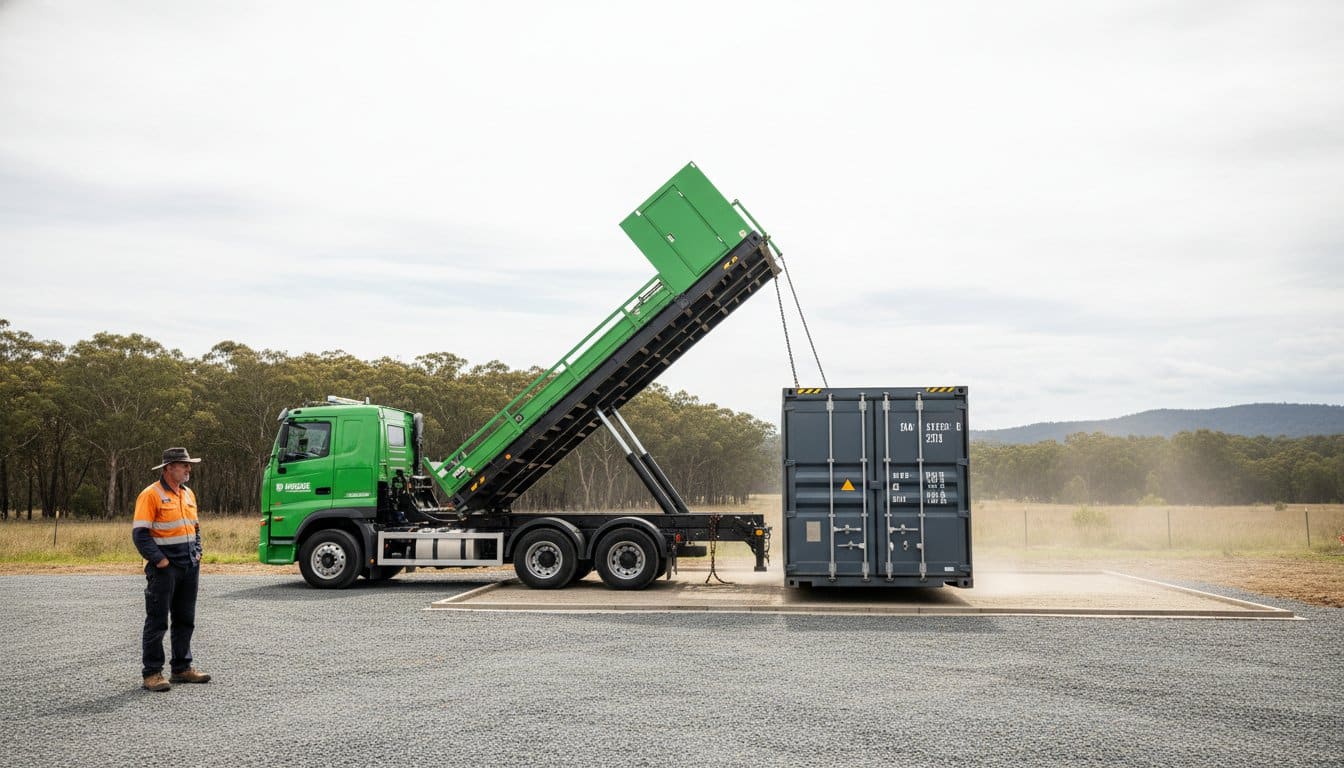
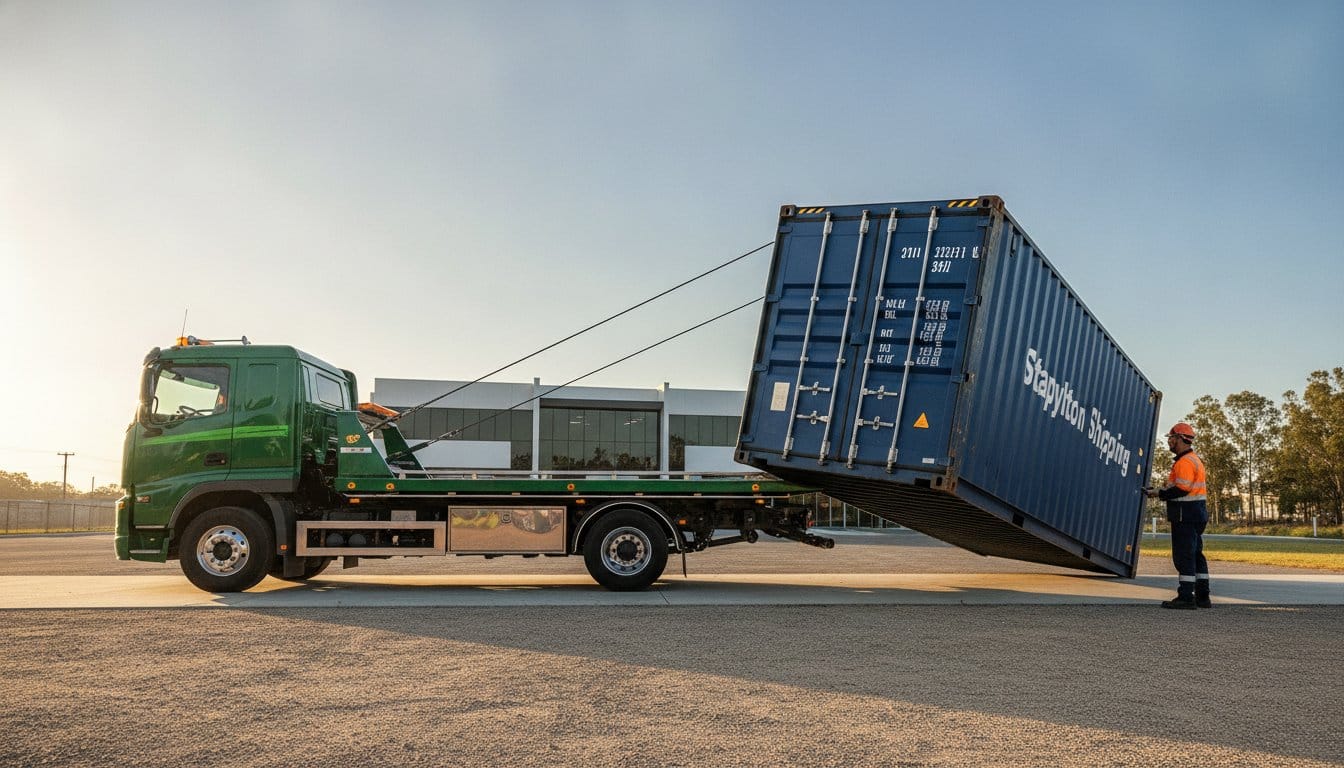
    The transition from ground to deck is the most technically demanding phase of shipping container towing. During this process, the hydraulic bed of a specialised tilt-tray truck reaches a significant incline, often approaching a 45-degree angle. This steep elevation requires a disciplined approach to ensure the structural integrity of the unit is maintained and any internal contents remain secure. While the steel exterior of an intermodal unit is designed for durability, the forces exerted during a tilt-load can be substantial if not managed by a specialist with an “Expert Guardian” mindset.

    To mitigate the risk of internal shifting, we advise clients to implement rigorous internal bracing before the truck arrives on site. Items should be strapped to internal lashing points or packed tightly to prevent movement when the unit is tilted. Once the container is successfully loaded, securing the load becomes a matter of strict compliance. We utilise heavy-duty chains and mechanical twist-locks as non-negotiable safeguards. These components lock the container directly to the chassis of the truck, providing a level of security and peace of mind that simple straps cannot match.

    The Winching Process Explained

    Our operators connect directly to the reinforced corner castings of the unit to ensure maximum structural integrity during the lift. A steady, controlled hydraulic pull is essential; sudden jerks or uneven winching can cause the container to rack or twist. A standard tilt-tray utilised for container transport typically maintains a maximum payload capacity of 10 tonnes to ensure structural safety and vehicle stability during the winching phase. This controlled power allows for a “soft landing” at the destination, where the hydraulic bed gently lowers the unit back to the ground with surgical precision, protecting both the asset and the underlying surface.

    Equipment Standards at Done Wright Towing & Transport

    We maintain a modern fleet specifically outfitted to navigate the M1 and the demanding local corridors of Logan and Stapylton. Our commitment to elite handling includes the use of non-abrasive techniques and specialised equipment designed to preserve the exterior finish of your asset. The “Done Wright” promise is built on the foundation of meticulous care, ensuring every relocation is executed with a focus on engineering precision rather than just speed. If you require this level of disciplined service, you can contact Done Wright Towing & Transport to discuss your specific site requirements. This methodical approach ensures your asset remains a prized possession throughout its journey across South-East Queensland.

    Essential Site Preparation for Successful Container Delivery

    Site preparation is the critical bridge between a successful relocation and a logistical stalemate. To facilitate professional shipping container towing, you must calculate the “Drop Zone” with engineering accuracy. A standard 20ft container requires at least 20 metres of straight-line clearance. This space allows the tilt-tray truck to align perfectly and slide the unit off the rear without the risk of impacting nearby structures or vehicles. Without this linear path, the operator cannot achieve the surgical placement your asset deserves.

    In South-East Queensland, particularly across the soft alluvial soils of Logan and the northern Gold Coast, ground stability is a non-negotiable factor. A laden truck can easily become bogged in damp earth, which is why we insist on a firm, compacted surface before arrival. You must also identify and mark underground services, such as septic tanks, drainage pipes, or telecommunications cables. These hidden hazards often lack the structural integrity to support the concentrated weight of a heavy vehicle. Similarly, look up to identify low-hanging branches or power lines that could obstruct the tray during its 45-degree tilt.

    Long-term placement requires a level foundation to prevent the container from “racking.” If the ground is uneven, the doors may become difficult to operate or the structural seals could fail over time. We recommend using timber sleepers or concrete pads at each corner to distribute the weight evenly and provide a stable base that resists sinking during the wet season. This methodical approach ensures your unit remains functional and secure for years to come.

    Access Requirements for Heavy Tilt-Trays

    Our specialised transport fleet requires specific clearances to operate safely. Typically, you should ensure a minimum width of 3 metres and a height clearance of 4.5 metres along the entire access path. Turning circles are equally important; the truck needs enough room to manoeuvre and exit the site once the container is on the ground. If your property features a steep driveway, please inform us during the planning stage. These scenarios often transition from a standard relocation into a complex recovery task that requires additional winching equipment and a higher level of technical discipline.

    The “Last Mile” Checklist

    Effective pre-delivery communication is the hallmark of a professional move. Our Stapylton-based team requires a site briefing at least 24 hours prior to confirm the orientation of the unit. You must decide whether you want the doors to face the truck cabin or the rear of the tray, as this determines how the container is loaded and ultimately dropped. For more detailed insights on managing these logistics, you can read our guide on shipping container transport in SE QLD. This meticulous checklist ensures that the final ten metres of the journey are as secure as the first.
    Shipping Container Towing in Stapylton & SE QLD: The 2026 Professional Guide

    Adhering to the legal framework for shipping container towing is a matter of public safety and professional discipline. In Queensland, operations are governed by the Tow Truck Act 2023 and the Tow Truck Regulation 2024, which mandate strict accreditation for drivers and specific vehicle standards. Beyond these state laws, we ensure full compliance with the National Heavy Vehicle Regulator (NHVR) protocols for oversized or heavy loads. Following the 2026 Load Restraint Guide is non-negotiable for our team; the “she’ll be right” attitude has no place in a high-stakes logistical environment where precision is the only acceptable standard.

    Local council regulations also play a vital role in a successful delivery. If you intend to place a container on a road verge or nature strip in Logan or the Gold Coast, you will likely require a temporary occupation permit. These permits ensure that the placement doesn’t obstruct visibility for motorists or damage underground council infrastructure. Engaging a fully licensed transporter provides the peace of mind that all regulatory boxes are ticked, shielding you from potential liability or municipal fines. If you are unsure about the specific requirements for your suburb, you can request a compliant transport quote from Done Wright Towing & Transport to ensure your project stays within legal boundaries.

    Weight Limits and Road Safety

    The distinction between moving an empty unit and a loaded one is significant for road safety. While an empty 20ft container weighs approximately 2.3 tonnes, a loaded unit can approach the maximum payload capacity discussed in earlier sections. We meticulously calculate axle weights to stay within legal limits, particularly when navigating the M1 or the Gold Coast Highway, where weighbridges and transport inspectors are active. This technical foresight is essential for long-distance transport and interstate backloads, where varying road conditions and steep gradients demand a perfectly balanced load to maintain vehicle stability.

    The Importance of Specialised Licensing

    General towing operators often lack the specific endorsements and equipment required for the unique demands of container transport. Our Stapylton-based operators undergo ongoing training to master the nuances of hydraulic winching and high-centre-of-gravity haulage. Professional container movers in Australia are required to maintain specific transit insurance and public liability coverage to ensure the protection of the asset throughout the entire loading and transport sequence. This “Expert Guardian” approach ensures that every driver behind the wheel of a Done Wright Towing & Transport vehicle is technically proficient and deeply respectful of the engineering standards required for a damage-free arrival.

    Why Done Wright is the Expert Guardian for Your Container

    Our operational hub in Stapylton serves as the strategic heart of our South-East Queensland network. This prime location allows us to provide rapid, disciplined shipping container towing across the industrial corridors of Logan, Brisbane, and the North Gold Coast with unparalleled efficiency. We don’t view ourselves as a mere haulage company; we are the Expert Guardian of your most significant investments. Whether we are moving a standard dry van or a complex site shed, our team applies the same meticulous care and engineering precision that defines our reputation in the region.

    Our expertise extends far beyond standard units. We possess the technical proficiency required for high-end machinery transport and the relocation of specialised portable offices. We understand that these assets often contain sensitive equipment or custom modifications that cannot withstand the rugged handling typical of general logistics providers. By choosing a partner that values craftsmanship and security, you eliminate the risks associated with shifting loads or structural stress. Every item is treated as a prized possession rather than just another task on the schedule.

    Transparent communication forms the backbone of our service. We provide clear logistical planning that de-risks the decision-making process for our clients. By offering a methodical approach to every task, we foster a sense of trust that is rare in the heavy transport industry. We understand the financial stakes involved in your relocation, and we ensure that our pricing and operational processes are as clear and reliable as the equipment we operate.

    Serving South-East Queensland and Beyond

    Local knowledge is a vital component of our service. Our operators are intimately familiar with the logistical challenges of the M1 and the specific access requirements of Stapylton’s industrial estates. For those moving further afield, we offer robust capabilities for interstate backloads and long-distance relocations, ensuring your asset receives premium care regardless of the distance. If you require a comprehensive towing service in Logan & Stapylton, our fleet is equipped to handle the task with quiet confidence and technical mastery.

    Book Your Container Relocation Today

    To provide an accurate quote, we require detailed information regarding your container type and the specific conditions of your delivery site. Clear logistical planning ensures there are no surprises on delivery day. We pride ourselves on providing a structured timeline and a firm understanding of the safety protocols involved in every shipping container towing project. Experience the Done Wright Towing & Transport difference, where prestige service standards meet heavy transport. You can Request a Quote from Done Wright Towing & Transport today to secure your relocation with the region’s premier specialists.

    Securing Your Logistical Success in 2026

    Navigating the complexities of shipping container towing requires a disciplined blend of engineering knowledge and local expertise. We have examined the vital importance of rigorous site preparation, from calculating the twenty-metre straight-line clearance to assessing ground stability across the Logan and Gold Coast corridors. By prioritising technical standards and NHVR compliance, you ensure that your asset remains a prized possession throughout every stage of the transition. Our Stapylton-based team stands ready to provide the professional authority and meticulous care your project demands.

    As a fully licensed and insured provider, we specialise in prestige-level care for all industrial assets, including containers, site sheds, and heavy machinery. We treat every task with the quiet confidence of an “Expert Guardian,” ensuring that your delivery is executed with surgical precision and transparent communication. Get your shipping container moved the right way by the experts at Done Wright Towing. We look forward to helping you achieve a seamless, secure relocation that keeps your site works perfectly on schedule.

    Frequently Asked Questions

    Can you move a shipping container that is still full of my belongings?

    You can move a container with contents inside, provided every item is rigorously secured and braced against internal lashing points. Because the unit tilts at a 45-degree angle during the loading phase of shipping container towing, loose items will shift and potentially cause structural damage or unbalance the vehicle. We recommend a full inventory check to ensure weight is distributed evenly before the winch process begins; to help with this preparation, you might explore LabelWriter 5XL for professional asset tagging and organisation.

    How much space does a tow truck need to drop off a 20ft container?

    A standard 20ft container requires a minimum of 20 metres of straight-line clearance for a successful delivery. This “drop zone” allows the tilt-tray truck to align perfectly and slide the unit off the rear without impacting fences or buildings. You must also ensure a minimum width of 3 metres and a height clearance of 4.5 metres to accommodate the truck’s hydraulic bed as it elevates during the unloading sequence.

    Do I need a crane to lift a shipping container onto a tow truck?

    You do not require a crane for most standard 10ft and 20ft relocations when utilising a specialised tilt-tray truck. These vehicles are designed to load and unload units at ground level using a high-tension winching system and a hydraulic bed. This method is significantly more cost-efficient and less logistically complex than coordinating an external crane hire for standard site shed or storage unit placements across South-East Queensland.

    What is the maximum weight a tilt-tray can tow for a container?

    The maximum payload capacity for a standard tilt-tray engaged in shipping container towing is typically 10 tonnes. This limit ensures the structural safety of the vehicle’s hydraulic system and maintains stability during the steep winching phase. If your unit exceeds this weight, or if you are moving a 40ft container, alternative heavy-haulage configurations may be required to remain compliant with Queensland transport regulations and axle weight limits.

    Will the tow truck damage my lawn or driveway during the delivery?

    While our operators exercise meticulous care, a heavy truck can damage soft lawns or thin decorative driveways, especially after heavy rain. We recommend assessing ground stability and using timber sleepers to distribute the weight at the final “drop zone” location. Our Stapylton-based team utilises non-abrasive techniques, but the sheer mass of a laden container requires a firm, compacted surface to prevent sinking or cracking during the delivery process.

    Are there any items that cannot be inside the container during transport?

    Certain hazardous materials and perishable goods are prohibited from being inside the container during transport for safety and compliance reasons. Items such as gas cylinders, flammable liquids, and explosive materials pose a significant risk during the tilt-loading process and may violate our insurance protocols. It is essential to declare any specialised cargo or dangerous goods before the truck arrives to ensure the safety of our operators and the public.

    How much does shipping container towing cost in Brisbane and the Gold Coast?

    The investment for container relocation varies based on the distance travelled, site accessibility, and the specific size of the unit. Factors such as steep driveways or the need for complex recovery winching can also influence the final logistical requirements. We recommend requesting a detailed quote to receive a transparent breakdown of the costs specific to your property and the current Queensland transport standards, ensuring there are no surprises on delivery day.

    Can you relocate a shipping container from a site with limited access?

    We can often relocate containers from sites with limited access, though these scenarios require advanced logistical planning and an “Expert Guardian” mindset. If a property features narrow gates or sharp corners, we may employ specialised recovery techniques or smaller tilt-tray configurations to achieve a successful drop. Providing our team with photos or a site briefing 24 hours prior allows us to prepare the necessary equipment for a disciplined, damage-free arrival.
  • Container Towing Service: The Essential Guide to Shipping Container Relocation

    Container Towing Service: The Essential Guide to Shipping Container Relocation

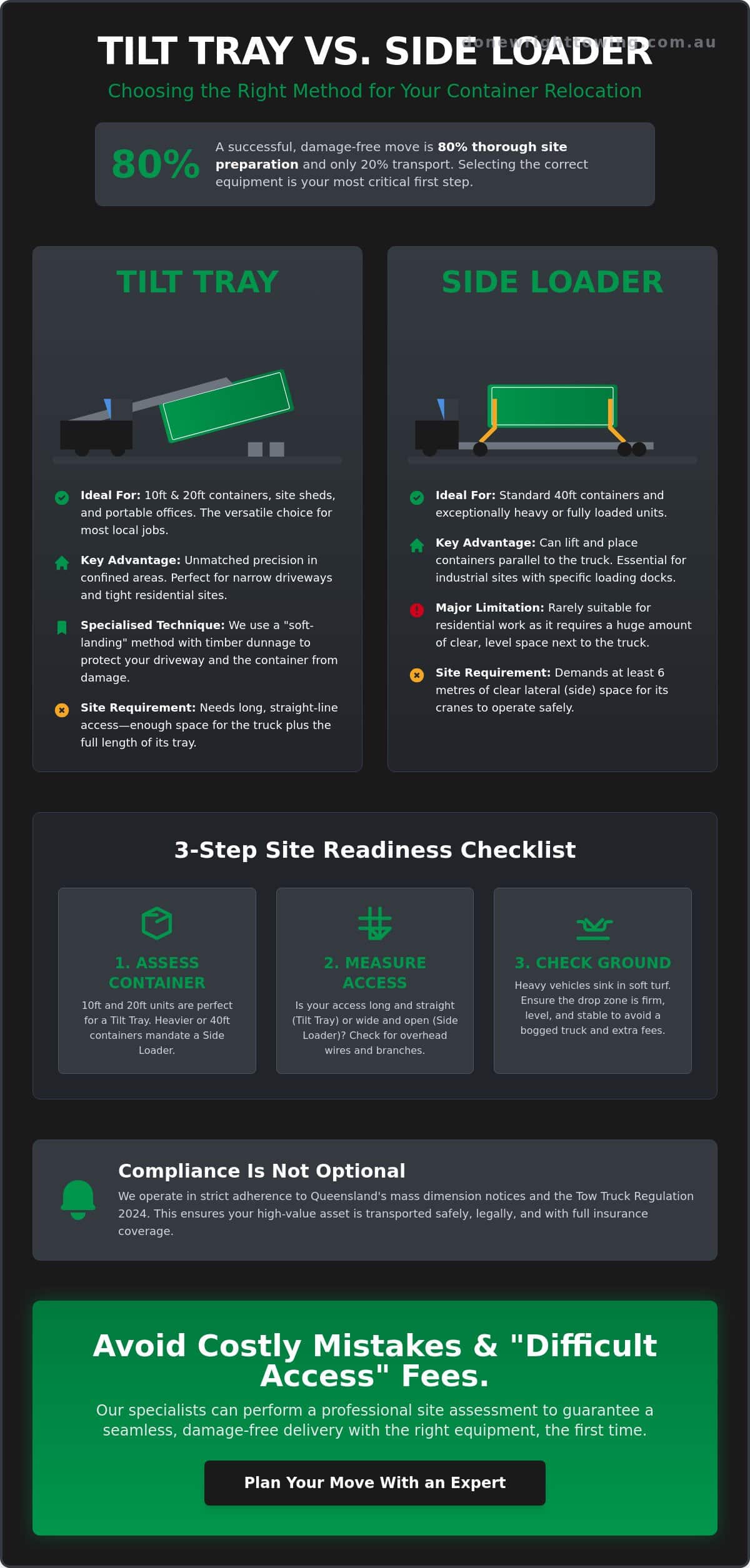
    Choosing the most powerful truck for your move might seem like the logical priority; however, a successful relocation is actually 80% site preparation and 20% transport. It is natural to feel uncertain about whether your container doors will face the right direction or if a heavy vehicle will sink into the turf on arrival. You probably want to avoid the frustration of “difficult access” surcharges or the risk of a bogged vehicle. These concerns are valid, especially under the strict standards of the Tow Truck Regulation 2024 and the high stakes of moving heavy site assets.

    By following this guide, you will master the logistics of a professional container towing service. We provide the specialised knowledge you need to select the correct equipment and prepare your ground for a seamless, damage-free delivery. We will explore the technical differences between tilt trays and side loaders, explain the current Queensland mass and dimension notices, and provide a practical checklist to ensure your site is ready for a precision arrival.

    Key Takeaways

    • Understand the technical distinctions between tilt tray and side loader methods to select the most efficient equipment for your specific 20ft or 40ft relocation.
    • Master essential site preparation techniques, including ground assessment and clearance checks, to prevent heavy vehicles from becoming bogged on-site.
    • Learn why a professional container towing service is required to safely manage ISO container dimensions while adhering to the Tow Truck Regulation 2024.
    • Discover how to correctly orient container doors and plan access routes to avoid unexpected “difficult access” fees and ensure a precision placement.
    • Gain peace of mind by identifying the security-focused standards that define a premium, damage-free transport operation across Queensland.

    What is a Professional Container Towing Service?

    Professional container towing is far more than the simple movement of a steel box from one site to another. It is a specialised relocation service designed for an Intermodal container, utilising high-capacity tilt trays or side loaders specifically engineered for heavy logistics. Unlike standard vehicle recovery, this process requires a deep understanding of weight distribution and structural physics. It’s a precision logistics task requiring accredited drivers and heavy-lift machinery to maintain the structural integrity of the asset throughout the relocation process.

    Standard tow trucks are entirely unsuitable for this type of work. A typical 20ft container can weigh up to 10 tonnes when loaded, and its 2.4-metre width exceeds the capacity of most light-duty recovery vehicles. Attempting to use under-equipped trucks risks catastrophic hydraulic failure or chassis damage to the vehicle. A professional container towing service uses reinforced tilt trays that provide a stable platform, ensuring the container remains secure even when navigating the undulating terrain often found on Queensland construction sites.

    We adopt an “Expert Guardian” approach to every job we undertake. We don’t view your container as mere cargo; we treat it as a high-value asset, whether it’s a mobile office, a storage unit for expensive tools, or a modified tiny home. This mindset ensures that we apply the same meticulous care and precision to a site shed as we would to a prestige performance vehicle.

    The Difference Between Transport and Basic Towing

    Cheap operators often rely on “drag and drop” methods that can cause significant harm. When a container is dragged across the ground or lifted unevenly, the frame can twist, leading to doors that no longer align or seal. We prioritise level loading to prevent internal contents from shifting during the transition. Done Wright is committed to doing things correctly the first time, using methodical loading techniques that protect the corner castings and the structural squareness of your investment.

    Common Container Sizes Handled

    Our fleet is equipped to handle the diverse range of units found across Stapylton and Logan. We frequently manage 10ft containers, which are popular for tight residential sites where space is at a premium. The 20ft container remains the industry standard for site sheds and commercial storage, requiring expert handling to ensure safe transit. We also specialise in modified units, including portable offices and site sheds, which often contain sensitive internal fit-outs that demand a smooth, vibration-controlled journey.

    Tilt Tray vs. Side Loader: Choosing the Right Method

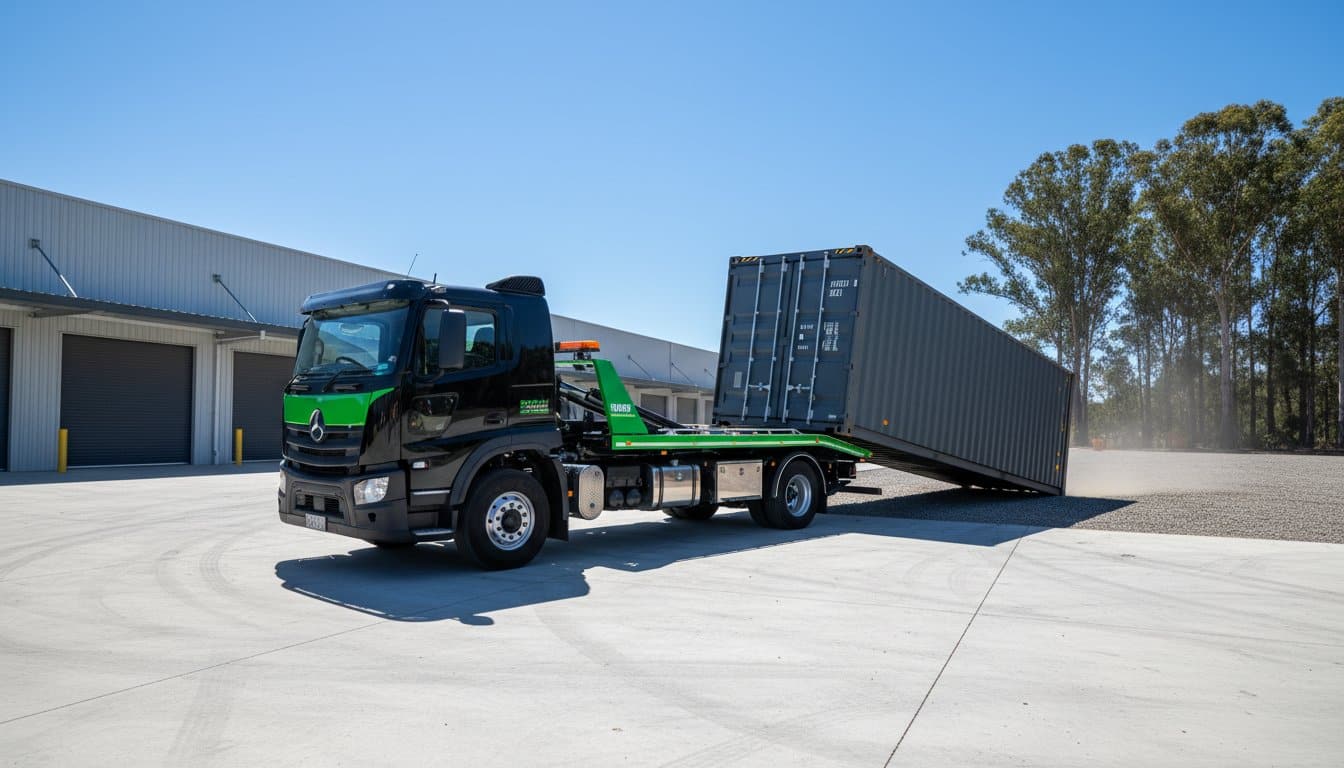
    Selecting the correct vehicle for your relocation is the most critical decision in the logistics chain. In South-East Queensland, operators typically deploy either a tilt tray truck or a side loader. Each has distinct mechanical advantages, but the choice depends entirely on your site’s physical constraints and the container’s weight. A tilt tray functions by sliding the tray back and tilting the rear to the ground; the container then slides off in a controlled, linear motion. This method is the backbone of a reliable container towing service because it allows for high precision in confined areas.

    Side loaders, by contrast, are specialised trailers that lift containers from the side using hydraulic cranes. While they are indispensable for 40ft containers or exceptionally heavy industrial loads, they require at least six metres of lateral clearance to operate. For the typical residential blocks found in Logan and Stapylton, this space is rarely available. Consequently, the tilt tray remains the most versatile and frequently requested option for local relocations. For a broader technical overview of equipment and planning considerations across the region, our shipping container transport guide for South-East Queensland provides in-depth guidance on navigating suburban and hinterland sites.

    When to Use a Tilt Tray Truck

    Tilt trays are the superior choice for 10ft and 20ft units, especially when you need to position the container in a narrow driveway or tucked behind an existing building. Our drivers utilise a “soft-landing” technique, where timber blocks or dunnage are placed strategically to buffer the container as it meets the ground. This meticulous care protects your driveway surface from scratches or structural cracking. Understanding the precise mechanics behind how a container tow truck operates its tilt-tray system is essential for property owners who want to prevent pavers from cracking or soil from becoming waterlogged under the vehicle’s weight. If you are unsure about your site’s suitability, you can consult our transport specialists for a professional site assessment.

    Understanding Weight Limits and Load Capacity

    Compliance with the Regulations and Safety in Queensland Transport is non-negotiable for heavy vehicle operators. There is a vast difference between transporting an empty “wind and watertight” unit and one fully loaded with household goods or heavy machinery. A standard single-axle tilt tray might handle up to 4 tonnes, whereas a multi-axle configuration is required for containers approaching the 10-tonne limit. You must declare an accurate weight estimate before booking. Overloading a vehicle not only risks a fine but compromises the braking and stability of the truck on the road.

    Container Towing Service: The Essential Guide to Shipping Container Relocation

    Essential Site Preparation for Container Relocation

    The success of a professional container towing service is determined long before the truck enters your property in Stapylton or Logan. While our drivers possess the technical skill to navigate complex environments, the physical state of your site remains the primary factor in a damage-free delivery. Preparation is about de-risking the arrival. You should walk the path the truck will take to identify soft spots or low branches. This simple act prevent delays and ensures the heavy vehicle doesn’t encounter hidden hazards that could lead to it becoming bogged or damaged.

    A standard 20ft container creates a significant footprint, but the truck carrying it exerts even greater pressure on the ground. The National Heavy Vehicle Regulator (NHVR) offers specific guidance on transporting freight in shipping containers, highlighting that the safety of the load is directly tied to the stability of the environment. If your site has recently experienced heavy Queensland rain, the ground may be too soft to support a 10-tonne load. Identifying these risks early allows us to plan for alternative entry points or delayed timing. Understanding how a 2.2-tonne steel box exerts constant pressure on the surface beneath it is essential; our detailed professional guide to shipping container transport in SE QLD outlines the critical site preparation steps needed to prevent structural damage to your property.

    Ground Surface and Footings

    Placing a container directly onto soft grass or bare earth is a recipe for long-term structural issues. Moisture trapped beneath the steel floor leads to rapid corrosion, while uneven sinking will cause the container frame to twist. We recommend preparing the site with concrete sleepers, treated timber blocks, or a compacted gravel pad. These footings must be level. If the site is even slightly off-centre, the internal contents may shift and the heavy locking bars on the doors will likely jam, making the unit unusable.

    The Door Orientation Trap

    This is the most common mistake made during the booking process. You must decide whether the container doors should face the truck cabin or the rear of the tray before we arrive for pick-up. Because a tilt tray slides the container off the back, the end facing the rear of the truck will be the first part to touch the ground. A container cannot be easily “flipped” once it is on-site without significant extra cost and space. Always communicate the door direction clearly so we can load the asset correctly at the point of origin.

    Clearance and Access Requirements

    Our trucks require substantial room to manoeuvre safely. Ensure you have assessed the following clearance markers:

    • Height: Minimum 4.5 metres of vertical clearance is required to avoid power lines, building eaves, and tree canopies.
    • Width: Gates and access paths should be at least 3.5 metres wide to accommodate the truck’s mirrors and tray.
    • Turning Circle: Heavy vehicles cannot make sharp, car-like turns; ensure there is ample room for the truck to swing into position.

    For a comprehensive guide to site readiness, refer to The Ultimate Shipping Container Relocation Checklist to ensure nothing is overlooked before the driver arrives.

    Regulations and Safety in Queensland Transport

    Relocating heavy assets across South-East Queensland is governed by a strict regulatory framework designed to ensure public safety and infrastructure longevity. The Tow Truck Act 2023 and the Tow Truck Regulation 2024 set the baseline for compliance in our industry. For operators, this means maintaining rigorous standards for vehicle maintenance and driver accreditation. The Port of Brisbane serves as the primary hub for regional container logistics; however, moving containers out of the port and onto regional roads requires specific adherence to the National Heavy Vehicle Regulator (NHVR) standards. These regulations dictate load restraint requirements to prevent shifting during transit, which is a critical risk when moving modified site sheds or loaded units.

    Choosing a licensed container towing service ensures that your transport provider understands these legal nuances. It isn’t just about avoiding fines; it’s about the Chain of Responsibility (CoR). Under Australian law, everyone involved in the transport chain, from the sender to the driver, is responsible for the safety of the load. Hiring a professional operator provides the security that your asset is being moved in full compliance with the latest mass and dimension notices, such as those governing oversized cargo on Port of Brisbane roads. This level of oversight is essential for maintaining the safety of other road users on the M1 and regional arterials.

    Insurance and Liability

    In our industry, “fully insured” is a term often used loosely by generalists. For a specialist like Done Wright, it means comprehensive public liability and transit insurance that specifically covers high-value site infrastructure. We treat your container with the same meticulous care as a prestige vehicle, utilising high-tensile chains and heavy-duty straps to secure the unit. This disciplined approach ensures that even if the journey involves rough terrain or sudden stops, the structural integrity of your container remains uncompromised. We provide immediate peace of mind by managing the financial and physical risks associated with heavy transport.

    Local Logistics: Stapylton to the Gold Coast

    Transporting heavy loads between Stapylton, Logan, and the Gold Coast requires strategic planning. The M1 is frequently congested, and navigating regional arterial roads with a 10-tonne load requires an experienced driver who can manage peak-hour traffic flow. We recommend scheduling relocations during mid-morning or early afternoon windows to avoid the worst of the Brisbane-to-Gold Coast bottleneck. For those managing more extensive infrastructure projects, our Reliable Machinery Transport services provide the heavy-lift capacity needed for site equipment and larger sheds.

    To ensure your next relocation is handled with professional precision and full regulatory compliance, request a secure transport quote from our expert team today.

    Done Wright: Professional Container Movers You Can Trust

    Done Wright Towing & Transport has established itself as the premier choice for specialised logistics in Stapylton and Logan. We approach every container towing service with the discipline and precision of an Expert Guardian. This means treating a steel site office or storage unit with the same level of security-focused care we apply to prestige car transport. We understand that your container isn’t just cargo; it’s an essential component of your business operations or a secure home for your personal investments. Our team maintains a steady, structured rhythm that de-risks the decision-making process, moving you from a state of concern to total confidence in our elite handling capabilities.

    Our Commitment to Quality

    Our family-owned business operates with a commitment to doing things correctly the first time. We leverage deep local knowledge of the North Gold Coast and Logan regions to navigate the specific challenges of Queensland’s road network, from the busy M1 corridor to the narrow residential streets of Stapylton. Whether we’re moving a 20ft site shed or a 10ft garden storage unit, our track record in reliable towing services is built on a foundation of trust. We don’t just “tow”; we transport with a focus on damage prevention, utilising the same methodical safeguards that enthusiasts trust for their performance vehicles. This localised yet expansive operational reach across Queensland ensures your assets are always in safe hands.

    Booking Your Container Relocation

    Booking your next container towing service with us is a structured process designed to eliminate uncertainty and prevent nasty surprises on delivery day. To provide an accurate, transparent quote, we require specific details: the container’s dimensions, an estimated weight, site photos, and your required door orientation. This data is critical for ensuring compliance with the Tow Truck Regulation 2024 and the National Heavy Vehicle Regulator standards. By providing these details upfront, we can guarantee that the equipment arriving at your site is perfectly suited for the task. We offer clear geographic and contact information, ensuring you can reach our Stapylton base whenever you need a reliable, high-standard partner. Contact our team today to secure a quote for your next precision relocation.

    Secure Your Next Relocation with Professional Precision

    Successful container transport is defined by meticulous planning and technical accuracy. You now understand that precision site preparation and the correct selection of a tilt tray vehicle are the primary factors in a damage-free delivery. Whether you are managing a residential move in Logan or a large-scale project in Stapylton, aligning your door orientation and ensuring a level, stable ground surface will prevent the common pitfalls of amateur relocations. A professional container towing service provides the specialised expertise necessary to navigate the Tow Truck Regulation 2024 while treating your asset with the respect it deserves.

    Done Wright Towing & Transport has been family owned and operated since 2017. We are fully licensed and insured specialists in 10ft and 20ft relocations across Queensland. Our disciplined approach guarantees that every site shed and storage unit is handled with the same meticulous care as a prestige vehicle. Get a Professional Container Transport Quote from Done Wright to ensure your next move is executed with expert precision. We are ready to help you secure your site assets today.

    Frequently Asked Questions

    How much does a container towing service cost in Brisbane?

    Local transport for a 20ft container in Brisbane typically starts from approximately A$1,800 according to 2026 industry cost guides. For regional routes from the city to the Gold Coast or Sunshine Coast, prices generally range between A$500 and A$800 for a 20ft unit. These rates are influenced by the specific equipment required and the complexity of the site access at both the pickup and delivery points.

    Can you move a shipping container that is full of furniture?

    You can relocate a loaded container provided the total weight remains within the truck’s legal capacity and the contents are properly secured. A standard 20ft tilt tray can safely transport a unit weighing up to 10 tonnes including the payload. It is essential that the furniture is evenly distributed to prevent shifting during transit, which could compromise the vehicle’s stability on the road.

    Do I need a permit to put a shipping container on my driveway in Logan?

    Logan City Council currently allows a shipping container to be placed on private property for up to 30 days without a permit for the purpose of moving house. If you need to place the unit on a footpath or nature strip, you must apply for a temporary permit, which is usually limited to a 14-day period. Always check the most recent local laws before scheduling your container towing service.

    What is the best ground surface for a shipping container?

    A level, well-drained foundation such as a compacted gravel pad, concrete sleepers, or treated timber blocks is the best surface for a container. These materials prevent the steel structure from sinking into soft soil and protect the underside from moisture-induced corrosion. A flat surface is also critical to ensure the container frame remains square, preventing the heavy locking bars on the doors from jamming.

    How much space does a tilt tray truck need to drop off a 20ft container?

    A tilt tray truck requires approximately 20 metres of straight-line clearance to unload a 20ft container safely. This distance accounts for the length of the truck itself and the space needed for the container to slide off the rear of the tray. You should also ensure a minimum width of 3.5 metres to allow for the vehicle’s mirrors and the safe deployment of the hydraulic equipment.

    Can you move a container from the Port of Brisbane to a residential address?

    Relocating an asset from the Port of Brisbane to a residential address is a routine task for a professional container towing service. This process requires strict adherence to the Queensland Class 3 Heavy Vehicle Mass and Dimension Notice to ensure the load is compliant with suburban road regulations. Our drivers manage the necessary safety checks to facilitate a secure transition from the port to your property.

    What happens if my site has a steep slope?

    Steep slopes present technical challenges for the hydraulic tilting mechanism and the stability of the container during the unloading process. If your site has a gradient exceeding 5 degrees, a professional site assessment is necessary to determine if a safe delivery can be performed. In many cases, we utilise specialised dunnage or timber blocks to create a level landing zone and maintain the structural integrity of the unit.

    Are your drivers licensed to handle heavy machinery and containers?

    Every driver in our fleet is fully licensed and accredited under the Tow Truck Act 2023 and the Tow Truck Regulation 2024. We maintain rigorous standards for handling heavy machinery and ISO containers, ensuring complete compliance with National Heavy Vehicle Regulator safety protocols. This professional accreditation ensures that your high-value site infrastructure is managed by disciplined, technically proficient experts who prioritise safety above all else.

  • The Ultimate Shipping Container Relocation Checklist for Stapylton & Logan

    The Ultimate Shipping Container Relocation Checklist for Stapylton & Logan

    Last Tuesday, a Logan property owner watched a 2.5-tonne empty unit sink into the notorious South-East Queensland black soil because the site wasn’t properly assessed for a heavy tilt-tray. It’s an expensive mistake that often results from a lack of technical preparation. We understand that a successful container relocation requires more than just a truck; it demands a meticulous approach to ground conditions and local regulations. You likely feel the weight of uncertainty regarding Gold Coast or Logan council permits and the fear of structural damage during the loading process.

    Our team at Done Wright Towing & Transport believes every asset deserves the same elite handling we provide for performance and classic cars. We’ve compiled this essential site preparation checklist to help you master your move and avoid the pitfalls of the Stapylton terrain. You’ll learn exactly how to stabilise your site, navigate 2024 local government requirements, and ensure a damage-free transition for your property. This guide provides the clear roadmap you need for a reliable, professional transport experience across Queensland.

    Key Takeaways

    • Master the essential measurements for vertical and horizontal clearance to ensure a seamless, damage-free delivery to your specific site.
    • Learn how to assess ground stability following South-East Queensland summer storms to prevent equipment bogging or site subsidence.
    • Identify whether a tilt tray or side loader is the superior choice for your 40ft container relocation based on space constraints and unit weight.
    • Navigate the complexities of Logan and Gold Coast City Council permit requirements and learn to time your move to avoid M1 Pacific Motorway peak-hour congestion.
    • Discover how our strategic Stapylton hub and meticulous “Done Wright” standards provide the expert care and security your high-value assets deserve.

    Understanding Container Relocation in South-East Queensland

    Moving a 20-foot steel box isn’t a simple tow. It’s a complex logistical manoeuvre requiring precision engineering and specialised equipment. In South-East Queensland, container relocation has evolved into a disciplined service that demands more than just a truck. Stapylton serves as the critical industrial hinge for this region. Positioned exactly 38 kilometres from the Brisbane CBD and 41 kilometres from the Gold Coast, this suburb provides the most efficient staging ground for heavy assets moving across the M1 corridor. For residents and businesses in Logan, the process involves navigating two distinct environments: the high-density residential streets of Logan Central and the expansive, often soft-soiled acreage blocks of Jimboomba or Munruben.

    The complexity of the job changes significantly based on the load. Transporting an empty unit is straightforward, but a “self-pack” relocation involves moving a client’s entire life or inventory. These loaded units present a shifting centre of gravity that requires a methodical approach to transit. As of 2024, transport data indicates that 65% of regional relocation delays stem from inadequate site preparation or using the wrong class of vehicle for the specific terrain. Whether you’re moving a home office or a full workshop, the success of the move depends on a provider who treats the asset with the same care as a performance vehicle. Understanding the full scope of a professional container towing service — from equipment selection to ground preparation — is the foundation of a damage-free outcome.

    Why Precision Matters for Your Steel Box

    Structural integrity is the primary concern during any container relocation. Improper lifting techniques cause “wracking,” a condition where the rectangular frame twists. Even a 5-millimetre deviation can prevent the heavy locking bars from sealing correctly, compromising security and weatherproofing. We apply “soft-loading” principles, a technique usually reserved for prestige car transport, to ensure the transition from ground to tray is seamless. This level of care is vital in Queensland, where high humidity and sudden 40mm downpours can turn a standard driveway into a bog. A local specialist understands how QLD clay reacts under the 10-tonne pressure of a loaded delivery vehicle.

    Standard Container Sizes and Weight Limits

    Most regional transport involves the Intermodal container, which typically comes in 10ft, 20ft, and 40ft lengths. Understanding the weight thresholds is critical for compliance with Queensland Department of Transport and Main Roads (TMR) regulations. A standard 20ft unit has a tare weight of approximately 2.3 tonnes, but once loaded, it can easily exceed 10 tonnes. While a standard tilt tray is sufficient for empty units, heavy self-pack containers often require specialised heavy-duty platforms. If a load exceeds 2.5 metres in width or specific axle weight limits, it may require Oversize signage or specific permits to legally traverse Logan’s road network.

    • 10ft Units: Popular for tight Logan residential blocks and small-scale storage.
    • 20ft Units: The industry standard for residential moves and site sheds.
    • 40ft Units: Generally require semi-trailer access and significant turning circles.
    • Weight Compliance: Always verify your gross weight to avoid heavy fines at TMR checking stations.

    The Meticulous Site Preparation Checklist

    Successful container relocation depends on more than just a powerful truck. It requires a disciplined approach to site logistics to ensure your asset arrives without a scratch. At Done Wright Towing & Transport, we treat every delivery with the same precision we apply to prestige vehicle transport. A site that isn’t properly prepared can lead to structural damage or costly delays. Follow these five steps to safeguard your property and your container.

    • Step 1: Measuring clearances. You must verify both vertical and horizontal paths. A standard tilt tray requires at least 3 metres of width and 4.5 metres of height to operate safely.
    • Step 2: Assessing ground stability. Logan’s clay-heavy soil can shift rapidly after QLD summer storms. A loaded container exerts massive point pressure that can sink into soft earth.
    • Step 3: Clearing the swing zone. The truck needs ample room to manoeuvre its rear end into position. Remove all parked cars, equipment, or debris within a 15-metre radius of the drop point.
    • Step 4: Levelling the landing site. If the ground is uneven by even a few degrees, the container frame may rack. This slight twist causes doors to jam, making them nearly impossible to open.
    • Step 5: Final walk-through for overhead hazards. Scan the area for low-hanging power lines, data cables, or tree branches. These are often overlooked until the tray is mid-tilt.

    Measuring Your Access Points

    Precision is the hallmark of a professional delivery. Your access gates must provide a minimum 3-metre clearance, but we recommend 3.5 metres to allow for the truck’s mirrors and natural pivot. Check your gate hinges and fence lines for any protrusions that could catch the vehicle. The “Straight Line” rule is vital here; a tilt tray typically requires 20 metres of straight-line space to offload a 20-foot container, and up to 40 metres for a 40-foot unit. If your driveway has a sharp bend, the truck may not be able to align correctly for the drop.

    Ground Conditions and Foundations

    The geography of Logan and Stapylton presents unique challenges, particularly on acreage blocks. Identifying “soft spots” is essential, as a 10-tonne vehicle can easily become bogged in saturated turf. To prevent this, we advise using heavy-duty timber sleepers or concrete pads at the four corners where the container will rest. This distributes the weight and prevents the steel from rusting in direct contact with damp soil. Safety is our priority, and managing the risks of transporting freight in shipping containers involves ensuring the destination can support the load without shifting. If you’ve had more than 20mm of rain in the last 24 hours, it’s often best to reschedule to ensure a damage-free delivery. For those seeking a seamless transition, our professional transport services provide the expertise needed for complex placements.

    The Ultimate Shipping Container Relocation Checklist for Stapylton & Logan

    Choosing the Right Equipment: Tilt Trays vs. Side Loaders

    Selecting the correct vehicle for your container relocation determines how safely and efficiently the unit lands at its destination. In the industrial and semi-rural pockets of Stapylton, where driveways can be narrow or unsealed, the machinery choice is never an afterthought. Done Wright Towing & Transport maintains a fleet specifically configured for the varied landscapes of Logan, ensuring that whether you are moving a 10ft garden shed or a 40ft site office, the equipment matches the load’s physical requirements.

    The Tilt Tray Advantage

    For roughly 85% of residential moves in Logan, the tilt tray remains the superior choice. This vehicle uses a hydraulic bed that tilts to the ground, allowing the container to slide off gently as the truck moves forward. The tilt tray is the “Swiss Army Knife” of transport because it combines hydraulic versatility with the ability to slide a container into position without needing secondary lifting equipment. This method offers precision placement, letting our operators tuck a unit into a corner or flush against a fence line with millimetre accuracy.

    Local moves often benefit from the higher availability and lower operational costs of tilt trays compared to heavy-lift cranes. Because these trucks have a smaller footprint, they navigate tight residential streets in Logan more effectively than larger articulated vehicles. We choose specific 8-wheel or 10-wheel configurations for Stapylton’s diverse terrain to provide the stability needed on uneven or soft ground.

    While tilt trays handle most 20ft units with ease, a side loader becomes necessary for 40ft units or sites where there isn’t enough room to pull forward. Side loaders use two hydraulic cranes to lift the container vertically and place it directly beside the truck. This is the preferred method when the container must be dropped in a space only slightly larger than the unit itself. Our detailed guide to container towing service equipment selection covers the technical differences between these vehicle types and how Queensland mass limits affect your choice.

    Safety Gear and Securing the Load

    Our commitment to safety mirrors the meticulous standards we apply to prestige car transport across Queensland. We treat a steel container with the same level of care as a high-value performance vehicle. This begins with the use of heavy-duty, 10-tonne rated winches and high-tensile chains that prevent any shifting during transit. Every operator follows the industry best practices outlined in the Safe Transport of Containers guide to manage load distribution and risk.

    To prevent structural damage or cosmetic scratching, we utilise specialised “soft-strap” systems and protective padding at contact points. Before hitting the M1, our team performs a final multi-point check:

    • Twist-locks: Ensuring the container is mechanically locked to the tray.
    • Winch Tension: Verifying the load is balanced and secured against lateral movement.
    • Weight Distribution: Checking that the centre of gravity is positioned over the rear axles for maximum stability.

    By applying these rigorous standards to every container relocation, we ensure your asset arrives in the same condition it left, regardless of the distance or the difficulty of the terrain.

    Executing a successful container relocation involves more than just mechanical force; it requires strict adherence to local government bylaws and strategic timing. The transition between Logan City and the Gold Coast involves two distinct regulatory frameworks that can stall a move if ignored. Professional transport isn’t just about the truck; it’s about managing the paperwork and the path to ensure a seamless arrival.

    Council Permits and Street Access

    Logan City Council requires a “Work on Council Land or Road Reserve” permit if your container will sit on a nature strip or road at any point. On the Gold Coast, verge placement is governed by similar strictures. Current 2024 fee schedules for Gold Coast road reserve permits typically start around A$156 for minor applications, though these costs vary based on the duration of the placement. You’ll need to apply at least 10 business days in advance to avoid delays.

    Street access is a matter of both law and etiquette. We recommend notifying neighbours at least 48 hours before the move. A large tilt tray truck needs significant swing room. Ensuring the street is clear of parked cars makes the process faster and safer for everyone involved. It’s this level of meticulous planning that separates a premium service from a standard tow.

    Transit Route Planning

    The M1 Pacific Motorway is the primary artery for any move involving Stapylton, but it’s notoriously volatile. We schedule moves to avoid the heavy congestion windows of 6:30 AM to 9:00 AM and 3:30 PM to 6:30 PM. Beyond the motorway, the Stapylton hinterland presents specific hazards like low-clearance bridges and 5-tonne weight-restricted roads. GPS units often fail to account for these heavy-vehicle limitations.

    Local drivers provide a distinct advantage here. They understand the “back roads” of South-East Queensland and can navigate around school zones during restricted hours. This expert knowledge ensures your asset isn’t idling in traffic or forced into a dangerous U-turn due to an unexpected height restriction.

    Insurance and Liability Standards

    Don’t accept “she’ll be right” when it comes to coverage. A professional operator maintains specific “Goods in Transit” insurance that covers the container during loading, transit, and unloading. This is separate from standard vehicle insurance. We also recommend verifying that the provider holds a minimum of A$20 million in Public Liability insurance. This protects you against property damage during the complex manoeuvres required for precise placement.

    For private property removals involving disputed sites, legal clarity is essential. We require documented proof of ownership or a signed release form before we can legally move a container from a third-party location. This disciplined approach protects all parties and ensures the container relocation is handled with total integrity.

    If you need a team that treats your assets with the care they deserve, book your professional transport service with Done Wright Towing & Transport today.

    The Done Wright Difference: Container Relocation Done Right

    Choosing a local partner for your transport needs makes a functional difference in the success of your project. Our family-owned Stapylton base isn’t just a depot; it’s the strategic hub for our South East Queensland operations. Being situated right in the heart of the industrial corridor allows us to respond rapidly to requests across Logan and the surrounding suburbs. We’ve built our reputation on the “Done Wright” promise, which means every container relocation is handled with the same level of meticulous care we apply to high-value prestige and performance vehicles. We don’t see a steel box; we see your workshop, your inventory, or your future home office.

    Our experience extends far beyond standard shipping units. We’ve successfully managed the transport of complex site sheds, heavy machinery, and specialty oversized equipment for various industrial sectors. This diverse expertise ensures that we understand the unique weight distributions and structural requirements of modified containers. We use professional-grade equipment and proven loading techniques to ensure your assets arrive in the exact condition they left.

    Expert Guardians of Your Assets

    We operate as the “Expert Guardian” of your property. This disciplined, detail-oriented approach is designed to reduce client stress by removing the guesswork from the transport process. We understand the emotional and financial stakes involved in moving large assets. Local Logan businesses and residents rely on us because we treat every job with professional authority. A local construction manager recently shared that our methodical approach to a multi-container move saved them significant downtime by ensuring every unit was levelled perfectly upon arrival. It’s this commitment to precision that separates a premium transport service from a standard towing company.

    Get a Quote for Your Relocation

    To provide a transparent price with no hidden surprises at the end of the job, we start with a thorough assessment. We’ve found that clarity at the beginning prevents complications later. When you reach out, please have the following information ready:

    • The exact dimensions and estimated weight of the container.
    • Details of any modifications, such as glass sliding doors or internal shelving.
    • Clear photos of the access points at both the pick-up and drop-off locations.
    • Information regarding overhead obstacles like power lines or low-hanging branches.

    Our quotes are comprehensive and reflect the high-standard, licensed, and insured service we provide. We don’t believe in low-ball estimates that grow once the truck arrives. Instead, we offer reliable figures based on the specific logistics of your site. You can Contact Done Wright Towing for a container relocation quote today to discuss your requirements with a team that values safety and precision above all else.

    Secure Your Container Relocation with Professional Precision

    Relocating a shipping container across Stapylton and Logan requires more than just heavy lifting. It demands meticulous site preparation and a technical understanding of specialised transport equipment. Whether you’re coordinating a tilt tray for tight spaces or a side loader for heavy-duty placement, getting the logistics right ensures your assets remain protected throughout the journey. Navigating local South-East Queensland regulations is much simpler when you have a partner who understands the specific terrain and council requirements of the Logan region.

    Done Wright Towing & Transport has been a family-owned and operated Stapylton business since 2017. We’re fully licensed and insured for heavy transport, bringing the same level of meticulous care to every container relocation that we provide for prestige and high-value assets. Our expert team manages the complex equipment selection and safety protocols so you don’t have to worry about the finer details. You can trust our proven track record of reliability and precision for your next project.

    Organise your container relocation with the Stapylton experts today

    We look forward to helping you move your container safely and efficiently.

    Frequently Asked Questions

    How much does it cost to relocate a shipping container in Logan?

    Costs for container relocation in Logan depend on the distance and site complexity, with local transport often starting from A$250. This fee covers the specialised tilt tray equipment and the expertise of a licensed operator. Final quotes vary based on whether the container is empty or loaded, as heavier units require more fuel and slower transit speeds to maintain safety standards.

    Can you move a shipping container that is full of personal belongings?

    You can move a loaded container, but you must pack it securely to prevent internal damage from load shifts. A standard 20ft tilt tray truck typically has a maximum lifting capacity of approximately 6 tonnes. If your belongings exceed this weight limit, you’ll need to source a heavy-duty side loader or crane truck to ensure a safe and compliant transport process.

    What is the maximum size container a tilt tray truck can carry?

    A standard tilt tray truck can carry a maximum container size of 20 feet. For larger 40ft units, you’ll need a specialised side loader or a semi-trailer. Because we focus on precision and safety, we limit our tilt tray services to 20ft containers. This ensures the vehicle stays within legal length limits and maintains the stability required for damage-free handling during transit.

    Do I need a permit to keep a shipping container on my driveway in Stapylton?

    You’ll need to check the Logan Planning Scheme 2015, as a permit is often required for containers kept on driveways for more than 30 days. For temporary placements on private property in Stapylton, council intervention is rare, but placing a unit on a nature strip or road reserve always requires a formal application. We suggest contacting Logan City Council to confirm specific zoning rules for your property.

    How much space does a truck need to drop off a 20ft container?

    A truck requires at least 20 metres of straight-line clearance to safely drop off a 20ft container. This space allows the tilt tray to extend fully so the truck can drive out from underneath the unit. You also need a minimum width of 3.5 metres and a vertical clearance of 4.8 metres to avoid hitting building eaves, gutters, or low-hanging tree branches during the delivery.

    Can a container be moved if it is sitting on soft grass or mud?

    Moving a container from soft grass or mud is possible, but it requires careful planning to prevent the truck from becoming bogged. If the ground is unstable, we may require you to provide 20mm thick steel plates or heavy timber sleepers to create a solid platform. This ensures the heavy-duty tyres maintain traction throughout the loading phase of the container relocation without damaging your property.

    What happens if there are power lines near the container drop-off point?

    Transporting near power lines requires strict adherence to Energex safety guidelines, which specify a minimum 3-metre exclusion zone for lines up to 33kV. If the drop-off point is too close to overhead wires, the driver will refuse the delivery to prevent an electrocution risk. We recommend identifying an alternative spot that maintains a clear 6-metre vertical clearance to ensure the safety of our crew and your equipment.

    Does Done Wright Towing provide interstate container relocation from QLD?

    Done Wright Towing & Transport focuses on providing premium transport services across Queensland, primarily serving the South East corner from our Stapylton base. While we specialise in local moves within Logan and the Gold Coast, we can facilitate hauls to regional areas across the state. For interstate requirements beyond the Queensland border, we recommend contacting a dedicated long-haul freight specialist to manage your project.