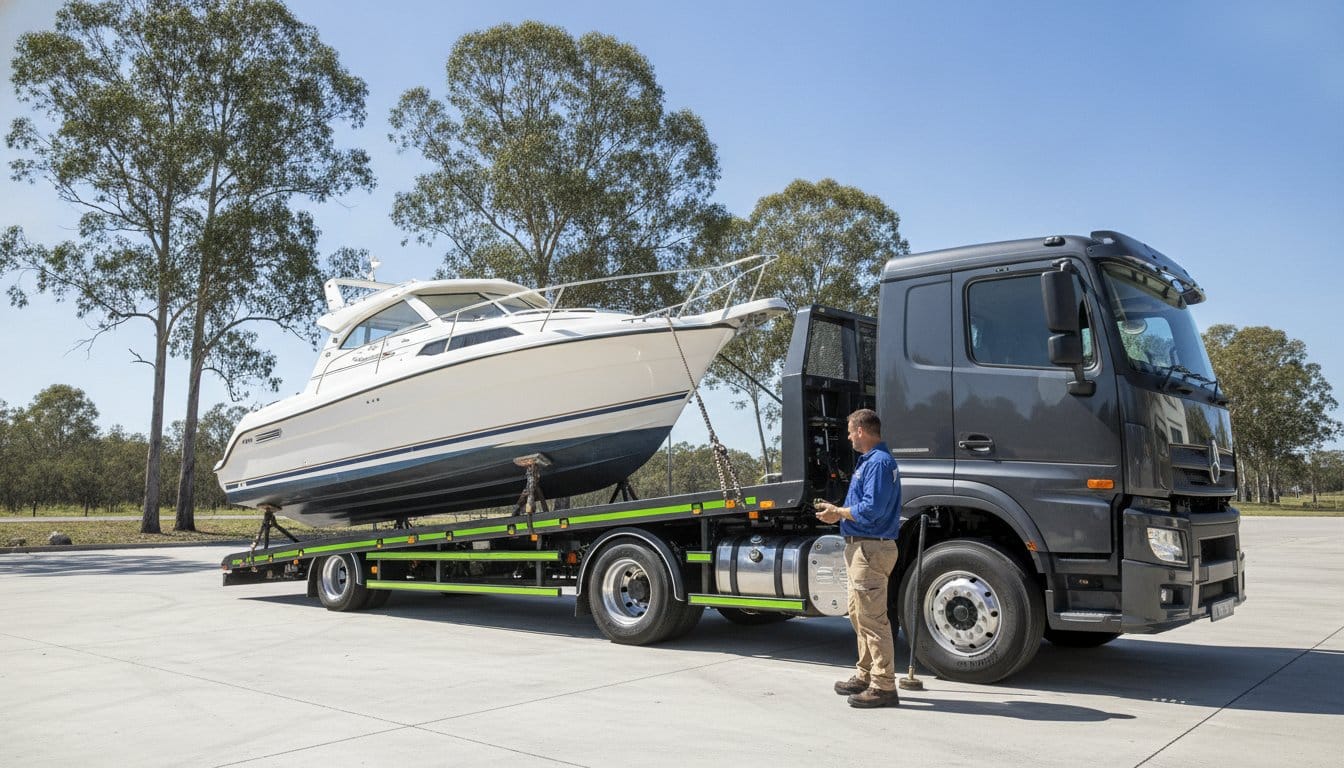
What if the most hazardous part of your weekend on the water isn’t the swell at the Gold Coast Seaway, but the fifty-kilometre transit back to your driveway? We understand that your vessel is far more than a simple asset; it’s a prized possession that represents years of passion and meticulous maintenance. The fear of structural stress, hull abrasions, or a catastrophic trailer failure on the M1 is a heavy burden for any owner to carry. When it comes to professional boat towing, you deserve a service that prioritises the engineering integrity of your craft above all else.
This 2026 guide provides the clarity you need to relocate your boat across South-East Queensland with absolute confidence and surgical precision. You’ll learn how to navigate complex oversize load permits and adhere to the latest Queensland road rules without the usual confusion. We will also examine the specialised equipment required for damage-free delivery and the elite handling standards that ensure your investment remains protected from the moment it leaves the water until it’s safely berthed at the marina or positioned in your driveway.
Key Takeaways
- Understand the 2026 Queensland road rules regarding vessel dimensions and permits to ensure your transit remains fully compliant and stress-free.
- Discover how professional boat towing services utilise an “Expert Guardian” methodology to protect high-value hulls and structural integrity.
- Evaluate the technical advantages of specialised tilt-tray transport over DIY methods to mitigate the risk of trailer breakdowns and mechanical fatigue.
- Master the critical pre-transport checklist for securing loose equipment and managing fluids before your vessel leaves the water.
- Learn why a Stapylton-based operational hub provides the ideal logistical advantage for boat owners across Logan and the North Gold Coast.
Professional Boat Towing: More Than Just a Hitch and a Trailer
Professional boat towing is a specialised logistics service that transcends the simple act of hitching a trailer to a 4WD. It requires a disciplined, detail-oriented methodology to ensure that high-value marine assets arrive in pristine condition. While many believe a standard tow ball and a bit of luck are sufficient, the reality of the Queensland highway environment suggests otherwise. A dedicated provider understands that a vessel is a complex piece of engineering that requires specific handling during land-based transit.
This is where the “Expert Guardian” approach becomes essential. It’s a philosophy that treats every vessel as a prized possession rather than just another task on a manifest. Unlike general logistics providers who might move a shipping container one hour and a boat the next, a specialist focuses on the unique engineering requirements of marine transport. For those unfamiliar with the fundamentals, understanding boat trailer basics is a good starting point, but professional transport adds layers of security that standard equipment simply cannot match.
The transit from a boat ramp to a driveway involves significant stressors that can compromise your vessel’s value. These include:
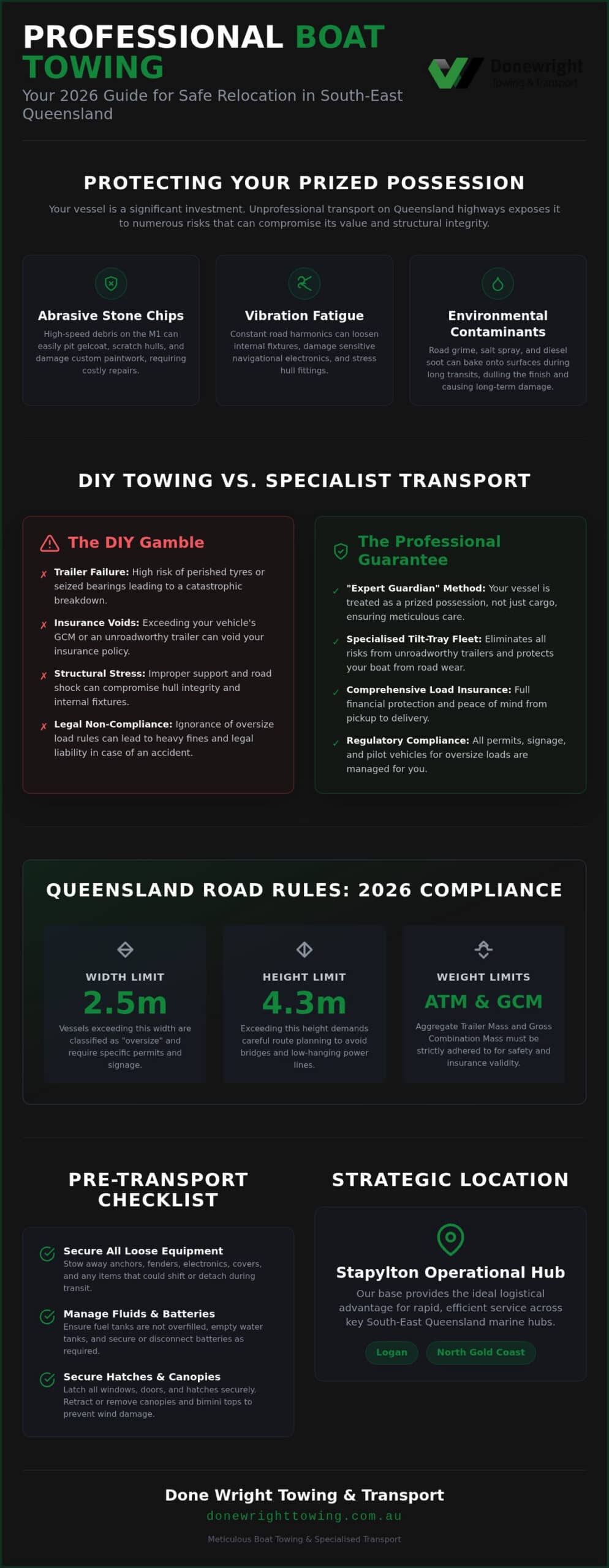
- Abrasive stone chips: High-speed debris on the M1 can easily pit gelcoat or damage custom paintwork.
- Vibration fatigue: Constant road harmonics can loosen internal fixtures and stress sensitive navigational electronics.
- Environmental contaminants: Road grime, salt spray, and diesel soot can bake onto surfaces during long transits.
The High Stakes of Marine Transport
For most owners, a boat represents both a significant financial investment and a deep emotional connection to the water. Maintaining the integrity of the gelcoat and the structural soundness of the hull is paramount. Professional relocation ensures that the vessel is secured using non-abrasive equipment designed specifically for marine finishes. A licensed specialist also provides comprehensive load insurance, offering peace of mind that a DIY tow simply cannot provide. This level of protection is vital when moving assets across the varied terrain of South-East Queensland.
When to Call a Professional Boat Mover
There are several scenarios where professional intervention is the only logical choice. Relocating a vessel to a new marina or a dry storage facility in Stapylton requires precise timing and reliable scheduling. If you’ve recently purchased a boat from a dealer or an auction, the existing trailer may be unregistered or, worse, unroadworthy. Attempting to tow a vessel with perished tyres or seized bearings is a recipe for a highway breakdown. In these instances, using a tilt-tray service ensures the boat is transported safely without ever putting a wheel on the bitumen.
Navigating Australian Road Rules for Boat Towing
Compliance on Queensland roads is not merely a matter of avoiding fines; it is a critical component of vessel safety and public liability. The legal framework governing boat towing in the Sunshine State is rigorous, designed to manage the unique challenges posed by long, heavy, and often wide loads. For owners in South-East Queensland, staying abreast of these regulations is the first step toward a successful relocation. Ignorance of the law provides no protection if a mishap occurs on the M1 or through the tight streets of Logan.
Queensland Dimension and Weight Limits
The standard width limit for a vehicle and trailer combination in Queensland is 2.5 metres. If your vessel exceeds this width, it is classified as an “oversize load,” requiring specific yellow-and-black warning flags and, in some cases, “Oversize” signage. Height is equally critical. While most standard trailers clear local infrastructure, any combination exceeding 4.3 metres requires careful route planning to avoid bridges and low-hanging power lines. Rear overhang, measured from the centre of the rear axle group to the end of the boat, must also remain within legal tolerances to prevent dangerous tail-swing.
Weight distribution is managed through two primary metrics: Aggregate Trailer Mass (ATM) and Gross Combination Mass (GCM). The ATM is the total weight of the trailer and its load when not attached to the tow vehicle, while the GCM is the maximum allowable weight of the entire rig. Exceeding these limits is a major safety risk and can void your insurance policy. Utilising a safe towing checklist can help you verify these weights and ensure your vehicle is capable of the task before you depart.
Safety Equipment and Lighting Regulations
Every trailer must be roadworthy and equipped with functioning indicators, brake lights, and clearance lamps. For larger vessels, the visibility of these lights is often obscured by the hull, necessitating the use of light boards or extended wiring. Safety chains are mandatory, and trailers with an ATM over 2,000kg must be fitted with an independent break-away system that applies the trailer brakes if it becomes disconnected from the tow vehicle.
Visibility is another legal sticking point. If your boat is wider than your tow vehicle, you are legally required to fit extended towing mirrors to maintain a clear line of sight along both sides of the trailer. If managing these technicalities feels overwhelming, choosing a professional transport specialist ensures your vessel meets every legal requirement without you having to study the transport manual. These regulations ensure that only those with the appropriate equipment and skill sets are handling heavy marine assets on our busy highways.
DIY vs. Specialist Transport: Protecting Your Pride and Joy
While the temptation to manage your own vessel relocation is understandable, the true cost of DIY boat towing often extends far beyond a tank of diesel. Many owners overlook the cumulative wear on their own vehicle’s transmission and the intense psychological stress of managing a multi-tonne load through the variable traffic of South-East Queensland. Professional transport isn’t merely a convenience; it’s a strategic decision to preserve the engineering integrity of your craft.
The Hidden Risks of DIY Towing
Physics is unforgiving on the highway. Incorrect tongue weight is perhaps the most common DIY error, leading to the dreaded “trailer sway” that can easily overwhelm a standard 4WD. Without the precise weight distribution managed by a specialist, a vessel can become an oscillating pendulum at 100km/h on the M1. Inadequate tie-down points on many recreational trailers are not designed for the sustained G-forces of long-distance road transit. This often results in structural stress on the hull or hairline fractures in the gelcoat that aren’t visible until the next time you hit the water.
The mental toll is also significant. Navigating narrow construction zones or merging with heavy freight vehicles requires a level of focus that can be exhausting for an occasional tower. A professional mover eliminates this burden, allowing you to focus on your destination while your asset is handled by a disciplined specialist. By elevating the vessel onto a heavy-duty tilt-tray with advanced suspension systems, we isolate the hull from the harsh vibrations of the bitumen. This significantly reduces “road shock,” which is vital for modern boats equipped with sensitive glass-cockpit electronics and delicate interior finishes.
The Done Wright Difference in Marine Logistics
We apply the same meticulous standards to marine assets that we use for prestige and classic car transport. Every relocation follows a methodical process designed to de-risk the transit. This protective approach includes:
- Non-abrasive securement: We utilise specialised soft-strap systems that provide immense holding power without ever marring the polished finish of your hull.
- Protective barriers: Strategically placed padding ensures that no metal components ever make contact with your vessel’s surfaces.
- Continuous monitoring: Our operators perform regular physical inspections of the load at scheduled intervals throughout the transit across SE QLD.
Our commitment to “Done Wright” execution ensures that the emotional and financial stakes of your investment are always protected by an expert guardian. This elite handling appeals to enthusiasts who are protective of their investments and require a reliable, high-standard partner for their logistical needs.
Pre-Transport Checklist: Preparing Your Vessel for the Road
Preparing a vessel for the highway requires a distinct shift in mindset from preparing for a day on the water. While the hull is designed to withstand the fluid dynamics of the ocean, it faces entirely different stressors when subjected to the high-velocity wind and constant vibrations of land-based transit. A meticulous pre-transport routine is the hallmark of a responsible owner and ensures that your boat towing experience remains uneventful and secure.
Wind resistance is a primary concern. At 100km/h on the M1, a loosely secured bimini or a trailing boat cover acts as a massive sail, creating immense structural torque on mounting points. All canvas tops, antennas, and outriggers must be retracted or removed entirely. Similarly, loose interior items such as cushions, life jackets, and fishing gear should be stowed in secure lockers or moved to the tow vehicle. These items are easily displaced by road-induced turbulence, posing a risk to other motorists and your vessel’s interior finish.
Fluid management is another critical, yet often overlooked, step. Ensure the bilge is completely drained to reduce unnecessary weight and to comply with biosecurity regulations regarding the transport of aquatic pests. We recommend keeping fuel levels to a minimum; a full tank adds significant mass and increases the load on the trailer’s suspension and braking systems. If you require a professional to handle these logistical complexities, you can book your boat transport today with our expert team.
Interior and Exterior Preparation
High-value electronics, including GPS units and fishfinders, should be removed and packed separately to protect them from both theft and vibration fatigue. The outboard motor must be trimmed down and secured with a dedicated travel bracket to prevent the hydraulic system from overextending during bumps. Finally, perform a thorough walk-around of the hull. Document the current condition with high-resolution photographs, focusing on the gelcoat and prop, to provide a clear baseline for insurance peace of mind.
Mechanical and Structural Stability
The physical connection between the boat and the trailer must be infallible. Inspect the winch strap for any signs of fraying or UV degradation, as this is your primary securement point. Safety chains should be rated for the load and free of heavy corrosion. Crucially, verify that all cabin hatches, windows, and portlights are securely latched. A hatch that catches the wind at highway speeds can be ripped from its hinges in seconds, leading to significant structural damage and potential road hazards.
Done Wright: Meticulous Boat Towing in Stapylton and SE QLD
The “Done Wright” philosophy is more than just a clever name; it is a verbal promise of perfection and a commitment to correct execution. Since 2017, our family-owned Australian business has specialised in the relocation of high-value assets, applying the same meticulous care to marine vessels that we provide for prestige automotive transport. Our operational hub in Stapylton serves as a strategic launchpad, allowing us to deliver reliable, scheduled service that respects both your time and the financial stakes of your investment.
Local Experts in Stapylton and Logan
Our location in Stapylton provides a distinct logistical advantage for boat owners across Logan and the North Gold Coast. We possess deep, technical knowledge of local boat ramps and marina access points, from the busy docks of Coomera to the quiet reaches of Jacobs Well. This regional familiarity ensures that your boat towing service is executed with an understanding of local tidal movements and ramp gradients, which is essential for the safe loading and unloading of larger craft.
Beyond our local region, we offer interstate backloads for owners relocating their vessels across state borders. Whether you are moving a trailer boat to Sydney or bringing a new purchase up from Melbourne, our fully licensed and insured team provides the same elite handling standards throughout the journey. We treat every item as a prized possession, ensuring that your vessel remains protected from road grime and mechanical stress during long-haul transits. Our reach is expansive, yet our service remains personalised, reflecting the disciplined standards of a specialist who understands the emotional and financial value of your craft.
Booking Your Marine Transport with Confidence
We believe that premium service should be accompanied by absolute transparency. Our quoting process is straightforward, providing you with a clear understanding of the logistical plan and the safeguards in place for your asset. On transport day, you can expect a methodical approach that begins with a physical inspection and concludes with a damage-free delivery to your specified marina or driveway. This disciplined process is designed to de-risk the relocation, moving you from a state of concern to a state of total confidence in our capabilities.
Our team is technically proficient and deeply respectful of the craftsmanship inherent in modern marine engineering. We understand that your vessel requires specialised knowledge that generalists often overlook. To understand the level of precision we bring to every task, you can learn about our prestige car transport standards, which serve as the benchmark for our marine operations. By choosing a partner that values precision and safety above all else, you ensure your boat is handled by an expert guardian who understands the stakes involved in high-end transport.
Secure Your Vessel’s Future on the Road
Relocating a high-value marine asset across South-East Queensland requires more than just a capable tow vehicle; it demands a disciplined approach to safety and compliance. By understanding the latest 2026 road regulations and following a meticulous pre-transport checklist, you ensure your vessel remains protected from the unique stressors of highway transit. Choosing professional boat towing over the risks of a DIY move eliminates the anxiety of trailer failure and structural damage, providing you with the peace of mind that your investment is in expert hands.
As a family-owned Australian business since 2017, we are fully licensed and insured to handle prestige assets with the precision they deserve. Our Stapylton-based team specialises in high-value transport, ensuring every vessel is treated with the same meticulous care as a classic car. When you are ready to move your pride and joy with absolute confidence, we are here to help. Request a meticulous boat towing quote from Done Wright Today and experience the difference of a true expert guardian. We look forward to seeing you back on the water soon.
Frequently Asked Questions
Do I need special insurance for boat towing in Queensland?
While your standard comprehensive marine policy might cover the vessel on the water, it often excludes or limits coverage during land-based transit. For professional boat towing, we provide comprehensive load insurance that protects your asset against transit-related risks. It’s essential to verify that your provider is fully licensed and insured specifically for high-value marine assets to ensure total peace of mind throughout the relocation process across South-East Queensland.
Can you tow a boat if the trailer is currently unregistered?
You cannot legally tow an unregistered trailer on its own wheels on Queensland roads. However, we can still relocate your vessel by utilising our specialised tilt-tray trucks. By loading the boat and its unregistered trailer entirely onto our transport vehicle, we eliminate the need for road registration or temporary permits. This method is the safest way to move newly purchased vessels or those that have been in long-term dry storage.
How much does boat towing cost per kilometre in 2026?
Pricing for professional marine transport is determined by several variables rather than a flat per-kilometre rate. Factors such as the vessel’s total weight, overall dimensions, and the specific accessibility of the pickup and delivery locations influence the final quote. We provide transparent, upfront pricing tailored to your specific logistical needs. This ensures you receive a precise estimate that reflects the meticulous care and specialised equipment required for your high-value asset.
What is the maximum width for a boat trailer without an oversize permit?
In Queensland, the maximum allowable width for a standard trailer and its load is 2.5 metres. Any vessel exceeding this dimension is classified as an “oversize load” and requires specific regulatory compliance. This includes the use of yellow-and-black warning flags, “Oversize” signage, and potentially specific route permits. We manage these legal requirements as part of our professional service, ensuring your wide-beam vessel is transported in full accordance with 2026 road rules.
Do you provide interstate boat transport from the Gold Coast?
Yes, we offer reliable interstate backloads for vessels moving beyond the Queensland border. From our strategic hub in Stapylton, we coordinate long-distance relocations to major hubs like Sydney or Melbourne. Every interstate journey adheres to our strict “Expert Guardian” standards, utilising the same damage-prevention technologies we apply to local moves. This provides a cost-effective yet premium solution for owners who require their prized possessions to be moved across state lines with meticulous care.
What happens if my boat trailer breaks down while you are towing it?
Our primary method of transport involves loading your vessel and trailer onto a specialised tilt-tray, which effectively eliminates the risk of trailer-related breakdowns on the highway. If you are using our breakdown towing service for a trailer that has already failed, we utilise professional recovery techniques to secure the rig safely. This proactive approach prevents common issues like seized bearings or tyre blowouts from escalating into a dangerous roadside emergency on the M1.
Can you transport a boat without a trailer using a tilt-tray?
We can certainly transport vessels that are not currently on a trailer. Our specialised tilt-tray trucks are equipped to handle hull-only relocations using non-abrasive blocking and secure cradling techniques. This service is ideal for boats being moved between hardstands, shipyards, or for vessels that are being sold without their original trailers. We ensure the hull’s structural integrity is maintained through precise weight distribution and soft-strap securement throughout the journey.
How do you protect the hull from stone chips during road transport?
Protecting the gelcoat from high-velocity road debris is a core part of our protective methodology. By elevating the vessel on a tilt-tray, we significantly increase the distance between the hull and the road surface, reducing the likelihood of chip damage. Additionally, we utilise specialised protective barriers and non-abrasive equipment to shield sensitive areas. This meticulous attention to detail ensures your vessel arrives at the marina in the same pristine condition it left the water.